
✓ Almost done
Do you want the polymer cover?
It protects your rangefinder from bumps and scratches. Most people opt to include one with their order.
Hit enter to search or ESC to close
✓ Almost done
It protects your rangefinder from bumps and scratches. Most people opt to include one with their order.






Copyright 2026 Sightlok LLC. All Rights Reserved. All Prices Are In USD. Privacy Policy / Terms & Conditions
Uploaded Failed |  |
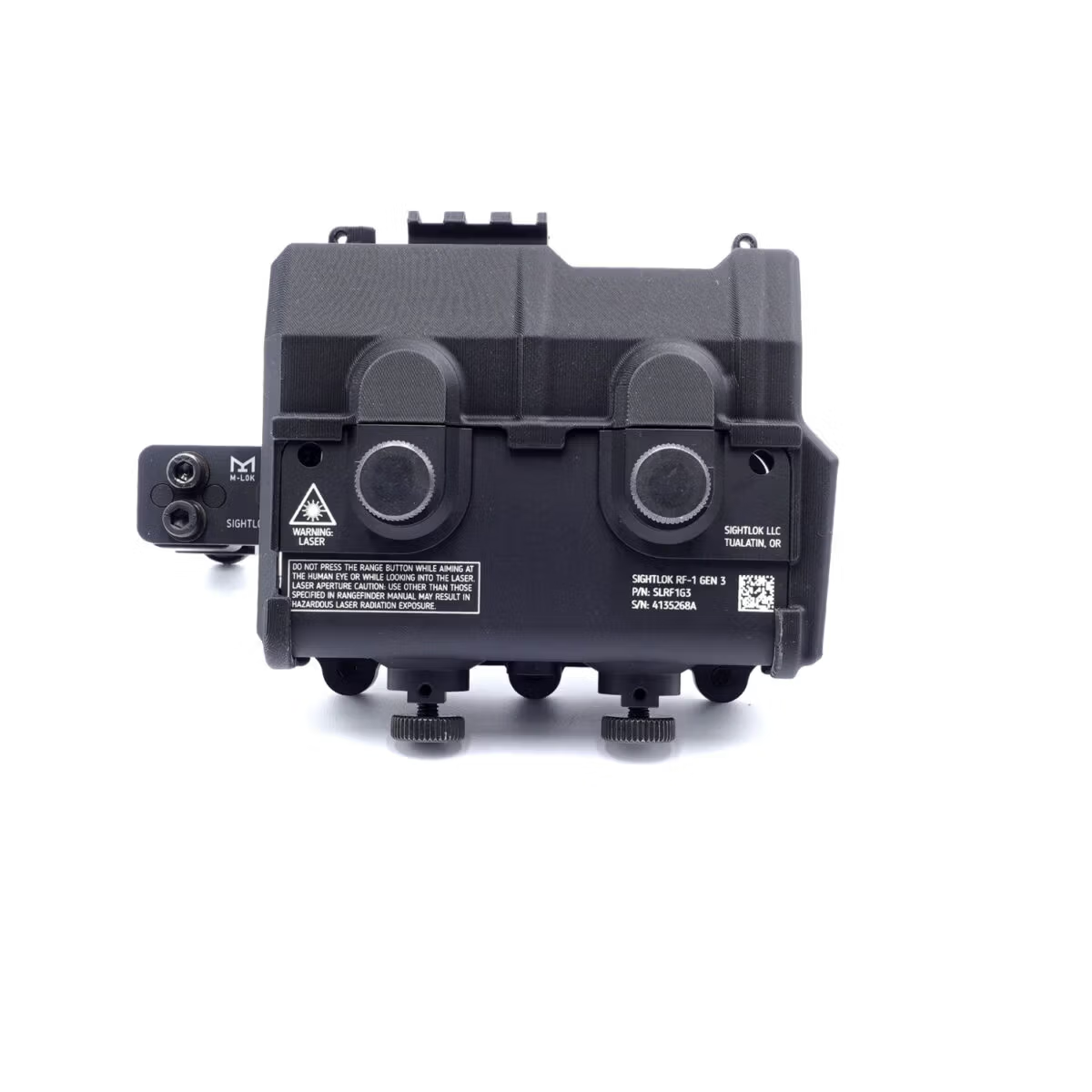
You are attempting to purchase a Sightlok RF-1 mount with no mounting accessories. If you do so, you will only be able to mount it using some non-standard route like bolting it to your MLOK handguard, buying a clamp from a 3rd party, or using it with a tripod. Are you sure you want to do this?

If your rangefinder was gripped in impact-absorbing rubber and dropped 6 inches, would you expect it to sustain any damage? Obviously not. That is why you can rest almost 100% assured that your rangefinder will be fine within the realms of regular cartridges.
Not 1 reported failure yet
In two years of selling this product, no customer has ever reported to us that their rangefinder was damaged by recoil.
Why our customers aren't having a problem with recoil
The reason our customers aren't having a problem with recoil is
1. Recoil is about the same as a 6-inch drop.
The recoil from a .308 is the equivalent of being dropped from a height of 6 inches. And that by itself isn't going to break any handheld rangefinder because they're designed to easily survive a 6 inch drop. Handheld rangefinders are not wine glasses — they are designed from the factory to withstand the impact of minor drops and bumps, and most are rated for roughly 3 foot drops. Six inches is a sixth of that.
2. 3M impact absorbing rubber on every surface.
Mitigating the force of the 6-inch drop is the advanced 3M impact absorbing rubber on all surfaces holding your rangefinder. It absorbs and spreads recoil force, and it surrounds the rangefinder on all sides, so no part of the rangefinder is ever directly exposed to recoil.
3. The force is spread out, not concentrated.
A drop lands on one corner — all the force through a single point. Recoil is spread along the bore axis through a clamp gripping a broad surface. Easier on the unit than a drop of the same magnitude.
Recoil tests on video
Below are videos of a US military rifleman testing two common cartridges with the Sightlok.
Sig Sauer KILO1000BDX versus .308 rifle recoil:
Sig Sauer KILO1000BDX versus 6.5 Creedmoor:
A: There are 3 ways to accomplish this:
1. Simple method
Point scope crosshairs at a target at the approximate distance you intend to shoot. Stabilize shooting platform so the scope doesn’t move. Use the windage and elevation knobs on the mount to point the rangefinder reticle at the same aiming point as the scope reticle. Re-verify scope reticle has not moved from the target. Verify rangefinder reticle matches aiming point of scope. For extra accuracy, measure the distance between center of scope occular lens and the center of rangefinder occular lens, and maintain rangefinder point-of-aim parallel to scope crosshairs to prevent point-of-aim divergence over large distances.
2. More accurate method
A more accurate method is to have a target at the approximate distance you intend to shoot, where you have a much longer distance behind the target to use as a contrast. Point scope at the edge of the target. Adjust rangefinder so that it detects the point at which aiming point goes off the edge of the target both horizontally and vertically. Fire rangefinder while moving off the edge of the target. The rangefinder should be aligned so that it switches to displaying the much longer distance behind the target just as scope crosshairs move off the edge of the target. Again, for extra accuracy, measure the distance between center of scope occular lens and the center of rangefinder occular lens, and maintain rangefinder point-of-aim parallel to scope crosshairs to prevent point-of-aim divergence over large distances.
3. Most accurate method – requires digital night vision clip-on like the PARD NV007
Third method is to use a clip-on digital night vision scope like a PARD NV007 or the cheaper “DIY” Night Vision scopes priced around $100. Digital night vision shows the infrared spectrum used by the rangefinder, so the laser from the rangefinder becomes visible flashing on the target. This makes windage and elevation adjustment for the rangefinder easy and precise. Again, for extra accuracy, measure the distance between center of scope occular lens and the center of rangefinder occular lens, and maintain rangefinder point-of-aim parallel to scope crosshairs to prevent point-of-aim divergence over large distances.