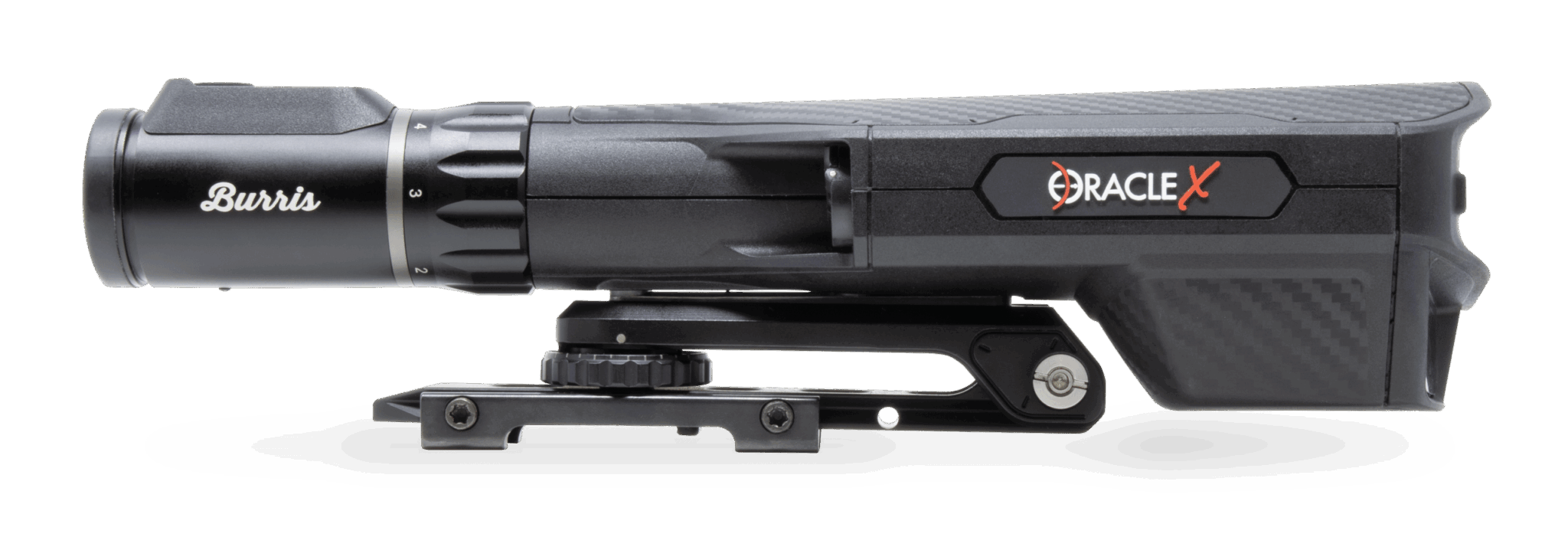
Q: Should I buy a Burris Oracle X?
A: Short answer: Absolutely not, especially if you want to fill your freezer when hunting season rolls around. This review explains why we’re not fans of the Burris Oracle X, and lists a far better alternative for you to consider.
Q: What problems does the Burris Oracle X have?
A: The top 9 most critical issues of the Burris Oracle X are:
2X is the lowest magnification it offers, giving you less than half the field-of-view of a 1X scope — too much magnification for the distance crossbow hunters actually shoot, so you end up hunting around for the animal inside the scope. More info here.
A battery that drains even when the scope is switched off — owners report a dead scope in about two weeks without firing a shot, and Burris’s own advice is to take the battery out after every use. More info here.
A mounting system that works loose and won’t hold zero — screws backing out after ten shots and a scope that rocks on the rail, in some cases through several replacements. More info here.
You can’t range anything without pointing your crossbow at it — no scouting a distance, and no ranging near other people or livestock. More info here.
Mediocre glass and poor low-light performance — which costs you exactly at dawn and dusk, when most game moves. More info here.
A wireless remote rather than a wired one — one more battery to manage, and the scope hunting for that remote is what drained the battery in the first place. More info here.
It weighs 30.8 ounces in a polymer body — heavy for what it delivers, and not an aluminum tube. More info here.
The display times out too quickly — so the range you just took disappears while you’re still settling into the shot. More info here.
Ranging failures in cold weather — owners report it refusing to return a range below freezing, which is late-season hunting. More info here.
Q: What’s the best alternative to the Burris Oracle X?
Q: What’s better than a Burris Oracle X?
A: A Sig Sauer EASY6-BDX 1-6X scope, a Sig Sauer BDX rangefinder, and a Sightlok RF-1 mount to co-witness the two. You still get the rangefinding scope you wanted — range it, get an illuminated aiming point, take the shot — but at true 1X, with more than double the field-of-view, and with a rangefinder you can take off the bow. Here’s what the finished setup looks like:
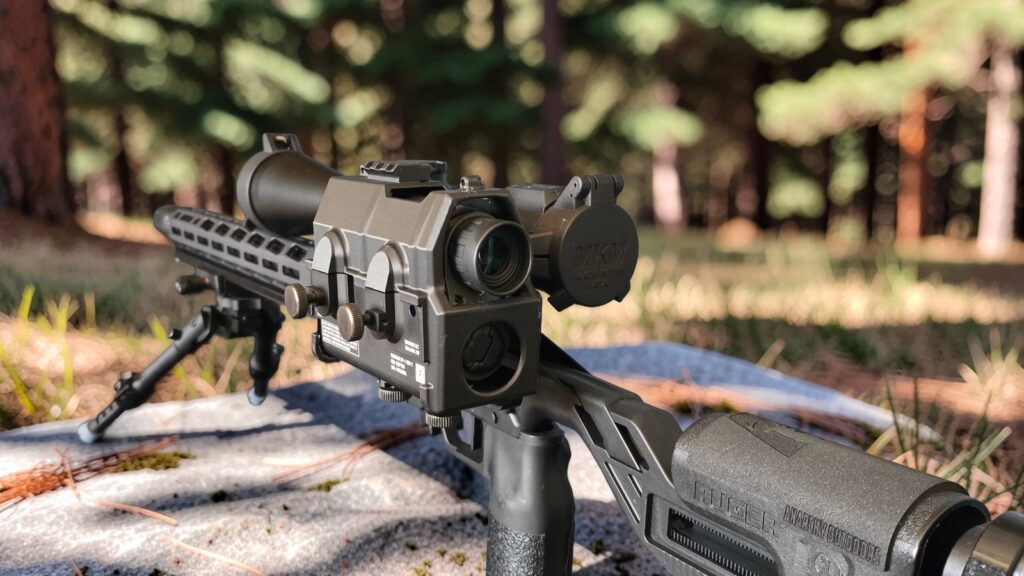
For more information about the Sightlok RF-1 and how it co-witnesses a handheld rangefinder with your scope, click here.
Q: What about the Burris Oracle X vs the Garmin Xero X1i?
A: We think the Burris Oracle X is the better of the two, because it can at least be dialed down to 2X while the Garmin Xero X1i is fixed at 3.5X. Neither would be a top recommendation. Our Garmin Xero X1i review is here.
👉 Read on for the field-of-view figures, the owner-reported failures, and what to buy instead.
Or jump straight to an answer: Is it worth it? · What magnification do I need? · Why does the battery keep dying? · Is it legal in my state? · What should I buy instead? · See all FAQs
For a few years the Burris Oracle X was the go-to rangefinding scope option for crossbows, and credit where it’s due: it got there first. It was the first crossbow scope to put a laser rangefinder and an angle-compensated aiming point in one package, and the Burris Forever Warranty behind it is a genuinely good warranty.
But the reason it was the only option has gone away. You can now mount a handheld rangefinder to a crossbow and co-witness it with a far better scope — and once that’s possible, the Oracle X’s compromises stop being worth accepting.
1. The Burris Oracle X Starts at 2X, Which Costs You More Than Half Your Field-of-View
If you’ve been following our blog, you already know we’re outspoken critics of excessive scope magnification. There’s a common misconception among hunters, shooters, and even scope manufacturers that more magnification is better. In practice more magnification usually means seeing less and seeing worse.
The Distances Crossbow Hunters Actually Shoot
A survey of 3,044 hunters found the average crossbow shot that hit its target was 22.4 yards, while the average missed shot was 32 yards. Even with today’s faster crossbows, the vast majority of successful crossbow hunts happen inside 50 yards.
At 22 yards you do not need magnification. You need to find the animal and put the aiming point on it before it moves.
The Field-of-View Numbers
Burris publishes them, and they tell the story:
| Scope | Field-of-view at 100 yards |
|---|---|
| Burris Oracle X at 2X | 47 feet |
| Burris Oracle X at 7X | 14 feet |
| Sig Sauer EASY6-BDX at 1X | 106 feet |
At its widest setting the Oracle X shows you less than half of what a 1X scope shows you. Dial it up and it gets dramatically worse.
Why That Decides Hunts
You spot the animal with your bare eyes, which are 1X. Then you have to find that same animal inside the scope. At 1X the sight picture through the scope matches what you’re already looking at, so the transition takes no time. At 2X you’re seeing half as much, and you’re moving the bow around searching for a deer you can see plainly without it.
The fix is the one we argue everywhere on this site: you don’t aim at low magnification, you find at low magnification. Drop to 1X, pick the animal up instantly, then zoom up and take the shot. A scope that won’t go below 2X takes the first half of that away from you.
2. The Burris Oracle X Drains Its Battery While Switched Off
This is the single most reported Oracle X problem among owners, and it isn’t a rumour — Burris has acknowledged it. There is a wire that continues drawing power when the unit is off. Owners describe putting a fresh CR123 in, leaving the scope alone, and finding it dead a couple of weeks later without a shot fired.
There is a firmware fix, but it isn’t something you can do yourself. The scope has to go back to Burris.
Burris’s Own Advice Is to Remove the Battery
Rather than a fix you can apply at home, Burris’s technical notes recommend removing the battery after use to maintain battery life.
Think about what that means in practice. Every time you finish hunting you’re expected to pull the CR123 out of your scope, and every time you go out you have to remember to put it back. Forget once and you arrive at your stand with a scope that does nothing.
Think about what it means in the middle of a season, too. You either send your scope away during the weeks you want to be hunting, or you live with a scope that quietly kills batteries between outings and hope you catch it before opening morning.
3. The Burris Oracle X’s Mount Works Loose and Won’t Hold Zero
The second most common owner complaint, and the most damaging one for a hunter. The mounting bracket carries the windage and elevation adjustments, and owners report it coming loose repeatedly:
- Mounting screws backing out after about ten shots while sighting in
- The scope rocking side to side on the bow even after everything is torqued down
- Zero shifting between sessions, so the sighting-in process starts over
- The problem persisting through replacement brackets, blue Loctite, and in several cases two or three complete scope replacements
One owner went through a replacement bracket, then a full replacement scope declared non-repairable by Burris, then a refurbished unit — and still couldn’t keep it tight. A rangefinding scope that can’t hold a zero is not a rangefinding scope. It’s an expensive way to miss.
Want Rangefinding, Ballistics, and an Aiming Point — at 1X?
The Oracle X puts all three in one unit, but it can’t go below 2X. No single product does all of it at 1X — you build it: a Sig Sauer EASY6-BDX 1-6X, a Sig Sauer BDX rangefinder, and a Sightlok RF-1 mount to co-witness them.
4. You Can’t Range Anything Without Pointing Your Crossbow At It
The rangefinder is built into the scope permanently, and that has a consequence most buyers don’t think about until they’re in the woods: to range anything at all, you have to point your crossbow at it.
That rules out scouting a distance before you’re set up, confirming a range on an animal you’re not ready to shoot, and ranging anywhere near other people or livestock. It’s not an edge case — it’s most of the ranging you’d want to do on a hunt.
It’s Also a State Law Problem
A number of states restrict or prohibit rangefinding optics mounted on a hunting weapon, and with the Burris Oracle X you have no way to comply short of taking the whole scope off your crossbow. Check your own state’s regulations before buying.
You Can Still Have a Rangefinding Scope Without This Problem
To be clear about what we’re recommending: we are not telling you to give up the thing that made you want an Oracle X. Ranging your target and getting an illuminated aiming point in the reticle is genuinely useful, and you should have it.
You just don’t need it welded into the scope. Put a handheld rangefinder in a Sightlok RF-1 mount, co-witnessed with your scope, and you range exactly where you’re aiming and get your aiming point the same way — but you can also flip a lever, pull the rangefinder off, range by hand, and click it back on without losing your co-witness. Same capability, none of this problem. We cover the full setup further down.
5. The Burris Oracle X’s Glass Is Mediocre, Especially in Low Light
This one comes up consistently, including from owners who otherwise like the scope and would buy it again. The glass is described as acceptable rather than good, and low-light performance is where it falls down hardest.
That matters more for a hunter than for most optics buyers, because game moves at dawn and dusk. The last twenty minutes of legal light are often the most productive of the day, and they’re exactly when mediocre glass costs you a shot.
6. The Burris Oracle X Uses a Wireless Remote
The Oracle X ranges either from a button on the scope or from a wireless remote you stick somewhere on the crossbow. The remote placement is genuinely good — better than reaching up to a rangefinder, and we’ll say so plainly.
But wireless means another battery to keep alive and another connection that can fail. It’s also directly implicated in the battery drain covered above: on the older firmware the scope was constantly searching for the remote, and that search is what killed the batteries. A wired remote can’t do that.
7. The Burris Oracle X Weighs 30.8 Ounces
Nearly two pounds of scope, 11.9 inches long, in a polymer body rather than an aluminum tube. The equivalent Sig setup — scope, rangefinder and mount together — comes to about 33 ounces, so the weight is broadly comparable. The difference is what you get for it: an aluminum tube, better glass, and a rangefinder that comes off.
8. The Burris Oracle X’s Display Times Out Too Quickly
A smaller complaint, but a recurring one. Owners report the readout shutting off sooner than they’d like, so the range you just took can disappear while you’re still settling in behind the bow — and you range again, which costs you movement and battery at the worst possible moment.
9. The Burris Oracle X Can Fail to Range in Cold Weather
Fewer reports than the problems above, but worth knowing: at least one owner had the scope refuse to return a range at temperatures below 30°F, sent it in, and had it returned with a new battery and a note that nothing could be found wrong.
Late-season hunting is cold by definition. A rangefinder that gets unreliable as the temperature drops is unreliable exactly when you’re most likely to be using it.
What to Buy Instead of the Burris Oracle X
No single product combines a rangefinder, a ballistic calculator and an illuminated aiming point at 1X. To get all three at a magnification that works at crossbow range, you build it:
Your Shopping List
– Sig Sauer EASY6-BDX 1-6X scope — about $1,000
– Sightlok RF-1 rangefinder mount — $250
– Sig Sauer KILO2200 BDX rangefinder — $130
Worth knowing how the system works: in the Sig BDX setup the ballistic solver sits in the rangefinder, not the scope. The rangefinder measures the distance, solves the firing solution, and sends the scope an illuminated holdover dot over Bluetooth.
Advantages of the Sig Sauer Build Over the Burris Oracle X
- More than double the field-of-view (106 feet vs 47 feet)
- At 1X it can be used both eyes open, like a red dot
- Much longer battery life, better glass, aluminum tube rather than polymer
- More elevation and windage adjustment, better reticle
- Higher resolution internal LED hold points
- Works with standard scope rings, and on both crossbows and rifles
- The rangefinder comes off in a second, for state law compliance and for ranging without pointing your crossbow at the target
Get the Oracle X’s Features Without the 2X Problem
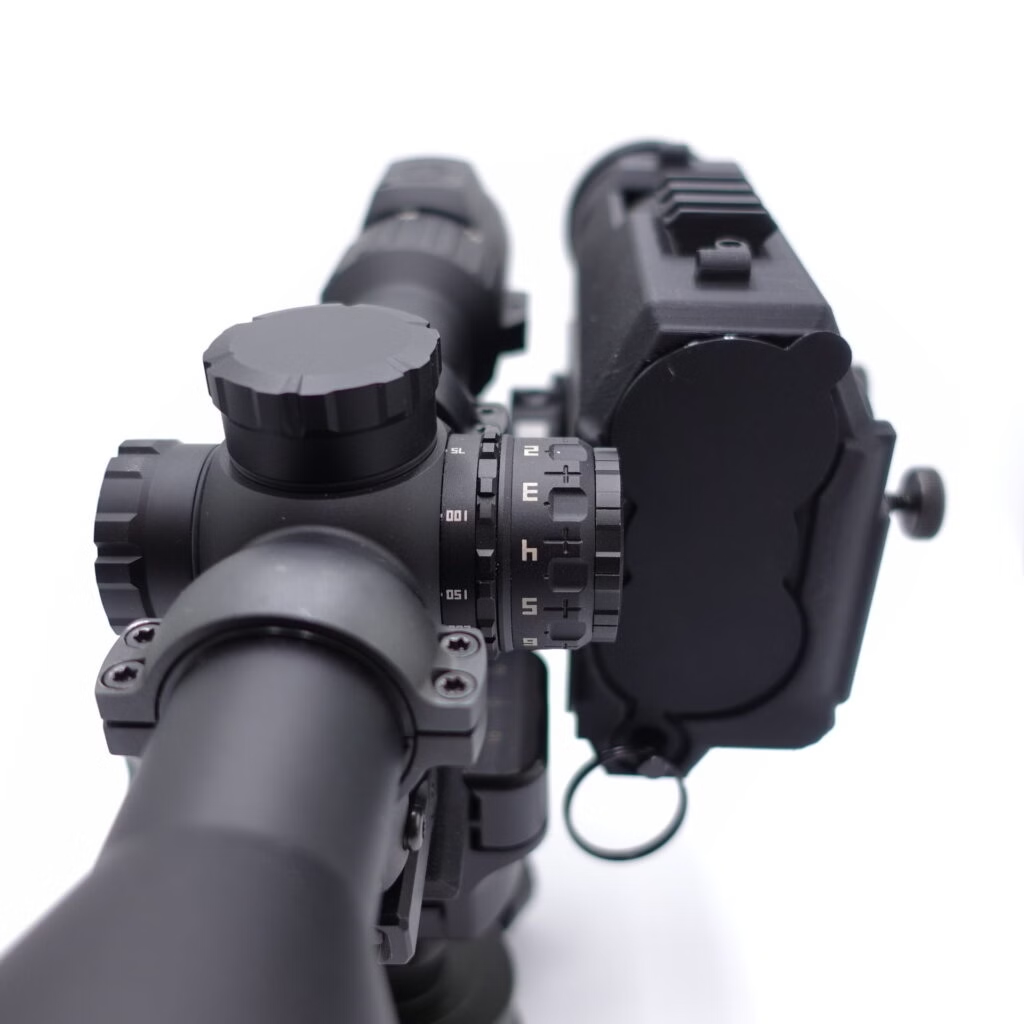
- Rangefinding, a ballistic calculator and an illuminated aiming point — the same three things the Oracle X gives you
- True 1X, so you find the animal instantly and then zoom to shoot
- More than double the field-of-view of the Burris Oracle X
- Removable rangefinder for state hunting law compliance
- Range a target without pointing your crossbow at it
Q: Is the Burris Oracle X worth it?
Q: Is the Burris Oracle X any good?
A: It was a genuinely clever product when it launched, and the Burris Forever Warranty behind it is excellent. But it can’t be dialed below 2X, which is too much magnification for shots taken at around 22 yards, and its widest field-of-view is less than half what a 1X scope gives you. Add the battery that drains while the scope is off, a mount owners struggle to keep tight, and a rangefinder you can’t remove, and there are better ways to spend the money.
Q: What magnification do I actually need on a crossbow scope?
A: 1X. The average crossbow shot that connects is 22.4 yards, and at that distance what you need is the widest field-of-view you can get, not a magnified one. A scope that starts at 1X also lets you shoot with both eyes open, like a red dot. Find the animal at 1X, then zoom up and take the shot.
Q: Why does my Burris Oracle X battery keep dying?
A: Because of a parasitic drain Burris has acknowledged — a wire continues pulling power when the scope is switched off, and on the older firmware the scope also constantly searched for its wireless remote. Owners report a fresh CR123 dead in about two weeks with no use. There is a firmware fix, but it is not a do-it-yourself job; the scope has to go back to Burris.
Q: Why won’t my Burris Oracle X hold zero?
A: The usual culprit is the mounting system. Owners report the two main mounting screws backing out after about ten shots, and the scope rocking on the rail even after everything is torqued and Loctited. Several have been through replacement brackets and complete replacement scopes and still had the problem.
Q: Is the Burris Oracle X legal to hunt with in my state?
A: Check your own state’s regulations before buying, because several restrict rangefinding optics mounted on a hunting weapon. The specific problem with the Oracle X is that its rangefinder is permanently integrated, so there’s no way to take it off and stay legal. A separate rangefinder on a quick-detach mount comes off in a second.
Q: How far can the Burris Oracle X range?
A: Burris quotes 500 yards on reflective targets and 200 yards on deer-sized game. The 200-yard figure is far more than a crossbow hunter needs, which is rather the point. The ranging distance was never the Oracle X’s weakness.
Q: What should I buy instead of the Burris Oracle X?
A: A Sig Sauer EASY6-BDX 1-6X scope (about $1,000), a Sightlok RF-1 mount ($250) to co-witness it, and a Sig Sauer KILO2200 BDX rangefinder ($130). You keep the rangefinding scope experience — range the target, get an illuminated aiming point, shoot — at a magnification that works at crossbow distance, with more than double the field-of-view.
Q: Why do I need a Sightlok RF-1 if I already have a scope and a rangefinder?
A: Because a handheld rangefinder in your pocket doesn’t help you at the moment of the shot. The Sightlok RF-1 mounts it to the crossbow and co-witnesses it with your scope, so you range exactly where you’re aiming — and it comes off the rail in a second when you have a target you want to range that you don’t want to point your crossbow at.
Who is Sightlok?
Sightlok publishes 100% factual, unbiased reports and reviews on electro-optics gear, with a particular focus on weapon-mounted laser rangefinders (WMLRF). Sightlok is the world’s leading independent expert on the various WMLRF options currently available. Sightlok is also the engineering and manufacturing team behind the highly-regarded Sightlok RF-1. If we can help someone find a product which perfectly meets their needs, or avoid a product which is less-than-ideal, our efforts were not in vain.
Where is this information sourced from?
The information is sourced from our own experiences with products in the field, and from customers we communicate with in the course of doing business, and from respected members posting on forums like Snipershide, Rokslide, and LongRangeHunting.
Did we miss anything in this report?
Disagree with anything we had to say?
Your opinion is precious, we would love to hear your feedback.
Any comments you leave below are published instantly, there’s no need to register before posting or verify your email address.
Ready to Build a Better Crossbow Setup?
Rangefinding, ballistics and an illuminated aiming point — at a magnification that actually works at 22 yards.
New here?
Mount your rangefinder to your weapon
The Sightlok RF-1 is a Picatinny / Weaver rail mount that turns the handheld rangefinder you already own into a weapon-mounted laser rangefinder.