
Q: Tango Fire 4000 or Sightlok RF-1 — which should I buy?
A: For most shooters, a handheld rangefinder in a Sightlok RF-1 mount. Paired with a $130 Sig Sauer KILO2200 it ranges further in the real world than the $1,500 Tango Fire 4000, puts a cleaner beam on target, has no firmware bugs affecting your firing solution, and costs $380 including the Sightlok RF-1 mount. The Tango Fire 4000 does win one category, and we cover it below.
Q: How did you compare the Tango Fire 4000 and the Sightlok RF-1?
A: Eight criteria, in rough order of how much they affect whether you get a usable firing solution. Each one is judged separately below and a winner named:
Q: What does the Tango Fire 4000 do better?
A: Triggering a range. Its wired remote sits by your trigger hand, so a range costs you a button press and nothing else. A handheld in a Sightlok RF-1 has no remote — you press the range button on the rangefinder itself, which means taking your support hand off the rifle to reach it. If the rifle isn’t on a bipod or a rest, that hand is holding the gun up. That’s the one significant downside of our setup.
👉 Read on for the head-to-head table and all eight categories.
Or jump straight to an answer: Which is better? · How much cheaper is it? · Which ranges further? · What does the Tango do better? · See all FAQs
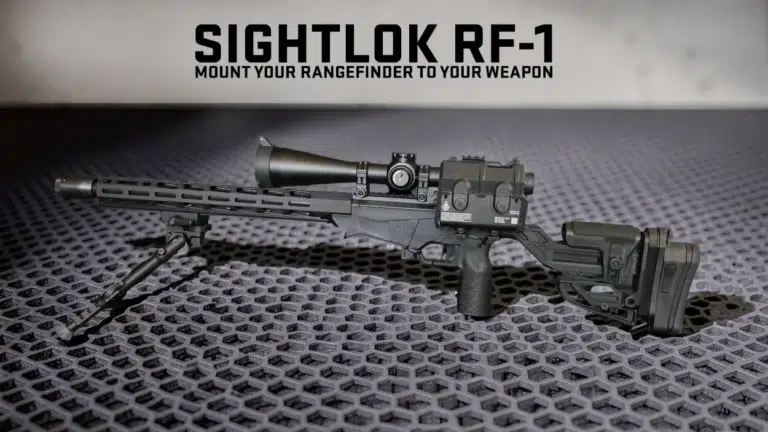
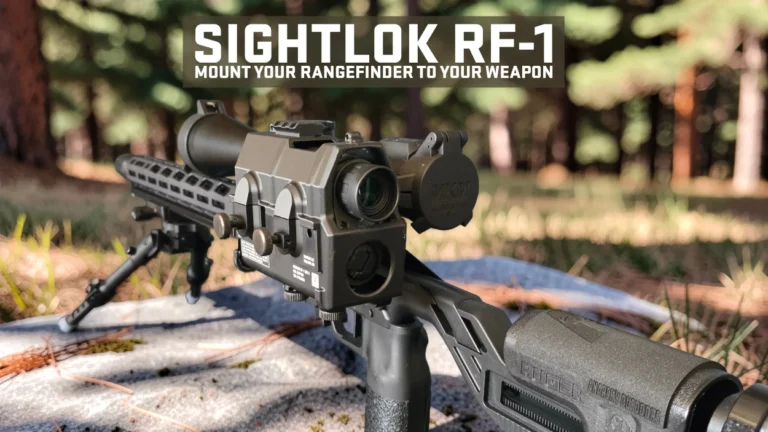
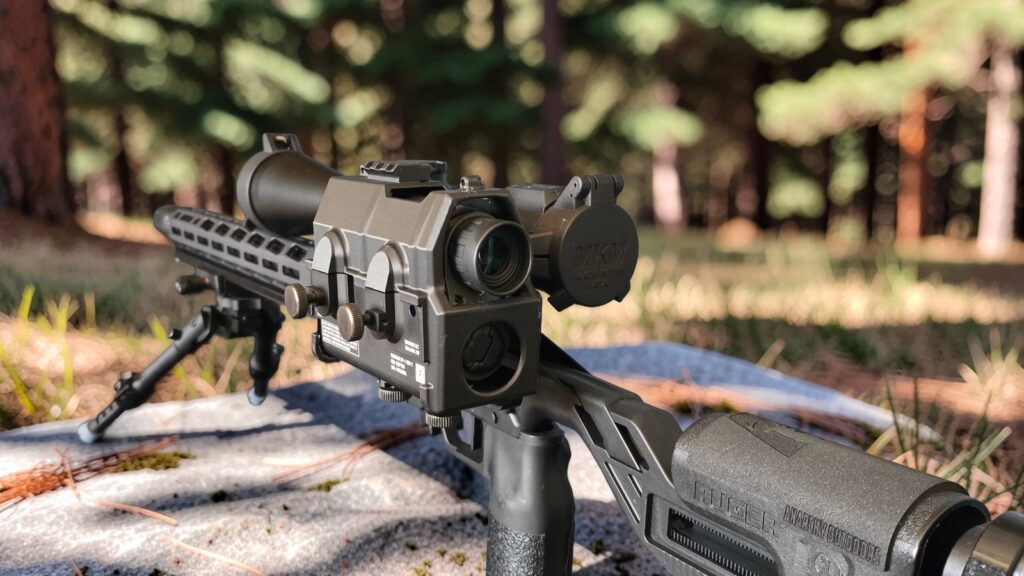
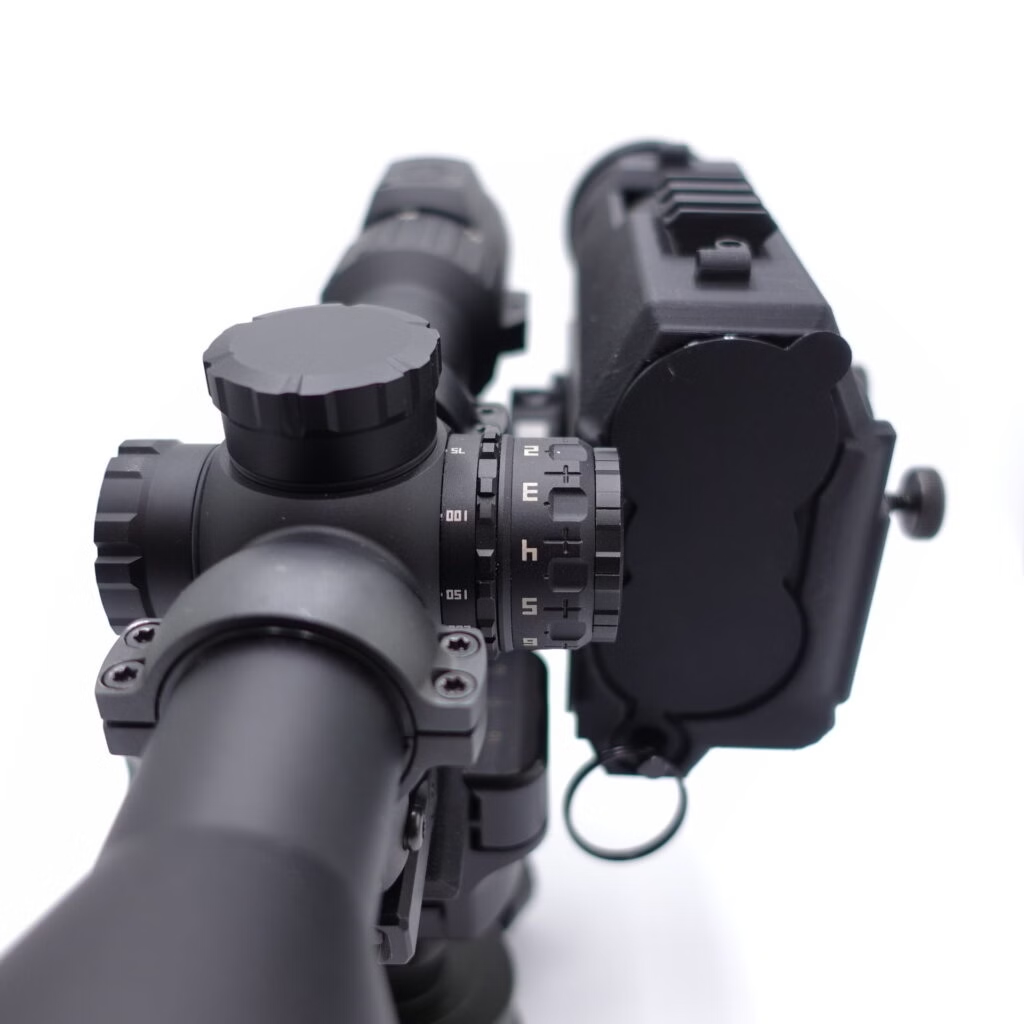
The Tango Fire 4000 is a dedicated weapon-mounted laser rangefinder: one sealed unit that bolts to your rifle and does everything. The Sightlok RF-1 is a mount that puts a handheld rangefinder you already own onto the rifle, co-witnessed with your scope.
For this comparison we paired the RF-1 with a Sig Sauer KILO2200 BDX, which costs $130. We picked it for one reason: its real-world ranging performance is in the same class as the Tango Fire 4000’s, so the comparison is fair on capability rather than stacked with an expensive flagship. That also makes the price gap stark.
To be clear, there is nothing special about the KILO2200 here. The Sightlok RF-1 works with almost any handheld rangefinder, so you’re not locked to one brand or one model. If you already own a decent handheld — Sig, Leica, Leupold, Vortex, whatever it is — it very likely performs as well or better than the KILO2200, and the only thing you’d be buying is the $250 mount. Everything below holds for that setup too.
Head to Head
| Criterion | Tango Fire 4000 | Sightlok RF-1 + KILO2200 | Winner |
|---|---|---|---|
| Price | $1,500 | $380 | Sightlok + Sig KILO2200 |
| Ranging trees | 1,500 yards | 1,600 yards | Sightlok + Sig KILO2200 |
| Ranging deer and elk | 1,200 yards | 1,300 yards | Sightlok + Sig KILO2200 |
| Beam quality | Wide, angled beam | Narrow, round beam — 1.4 MRAD on the KILO2200 | Sightlok + Sig KILO2200 |
| Environmental sensors | None | None on the KILO2200; available on Sig handhelds from the KILO3K up | Tie on the KILO2200 |
| Firmware reliability | Two unfixed bugs affecting dope | No known equivalent bugs | Sightlok + Sig KILO2200 |
| Triggering a range | Wired remote — instant | Button on the unit — support hand off the rifle | Tango Fire 4000 |
| Range without pointing your weapon | No — integrated unit | Yes — snaps off the rail | Sightlok + Sig KILO2200 |
| Ballistic software | Applied Ballistics, moving to a cloud app | Sig BDX, actively developed — also Applied Ballistics, but not the cloud version | Sightlok + Sig KILO2200 |
| Warranty and support | Poor documented record | Handheld maker’s warranty + US-based Sightlok support | Sightlok + Sig KILO2200 |
The Eight Categories
1. Ranging Performance and Price — Sightlok RF-1 + Sig KILO2200 wins
Wildly optimistic range estimates from the manufacturer notwithstanding, in real-world ranging the $130 Sig Sauer KILO2200 outperforms the $1,500 Tango Fire 4000: 1,600 yards versus 1,500 on trees, and 1,300 versus 1,200 on deer and elk.
You’re paying $1,500 for a product that is functionally inferior to a low-end $130 rangefinder. Think of the Tango Fire 4000 as a $100 rangefinder in a $1,400 box.
The price gap compounds it. The Sightlok-plus-Sig combination costs $380 against $1,500, a saving of more than $1,100, or about 75%. And if you already own a decent handheld rangefinder, you’re only paying $250 for the mount.
2. Beam Quality — Sightlok RF-1 + Sig KILO2200 wins
Tango Innovations doesn’t publish a beam divergence figure for the Fire 4000. Field reports describe the same failure mode that plagues the Vortex Impact 4000: a wide, angled beam that catches branches, grass and terrain alongside the target instead of isolating it.
Here is the Vortex Impact 4000’s beam photographed through night vision. Vortex publishes a figure for it — 2.0 x 0.2 MRAD canted at 45°:

That canted, slash-shaped smear is the whole problem in one picture. The Tango Fire 4000 shows the same real-world symptoms in the field, and we think it may actually share the same laser unit that’s used by Vortex.
The Sig KILO2200’s beam is 1.4 MRAD and round. Less spread on target, in a regular shape, means fewer false and blended readings around clutter.
3. Environmental Sensors — a tie with the KILO2200
The Tango Fire 4000 has no built-in environmental sensors:


Without onboard sensors you depend on your mobile phone or a Kestrel to get that data.
In fairness, the budget KILO2200 doesn’t have them either, so on the pairing we chose for this comparison, this category is a tie. The difference is that you have the option to fix it: Sig builds environmental sensors into BDX-enabled handhelds from the KILO3K up, so you can pick a handheld that has them. With the Tango Fire 4000 there is no version to move up to.
4. Firmware Reliability — Sightlok RF-1 + Sig KILO2200 wins
Two bugs, both reported on Snipershide, neither fixed.
First reported here: engage continuous ranging by long-pressing the remote or the onboard button, and after 2-3 consecutive ranges the unit keeps ranging but stops updating the dope. Rangefinding still works, so nothing tells you your firing solution has gone stale.
Separately, users reported that with the BOSS phone app connected, slope calculations use the angle of the phone rather than the angle of the rifle. Your angle correction ends up computed from however the phone is sitting in your pocket.
Months on, the TANGOINNOS rep is following the thread but there has been no meaningful response. A manufacturer that doesn’t acknowledge or fix bugs of this kind is a manufacturer you’re trusting with your firing solution.
Want a Rangefinder That Reads Through Brush?
The Sightlok RF-1 mount turns a handheld rangefinder into a weapon-mounted rangefinder that co-witnesses with your scope. Assuming you’re using a decent handheld like a Sig KILO2200 or better, you also get a narrower, cleaner beam than the Tango Fire 4000’s.
5. Triggering a Range — Tango Fire 4000 wins
This is the one the Tango Fire 4000 takes, and it takes it cleanly.
Its wired remote sits by your trigger hand. Press it and you have a range, every time, with no pairing step and no standing battery drain. It’s the fastest way to trigger a range of any option we’ve tested, and it’s better than the Bluetooth arrangement on the Vortex Impact 4000, which either has to be kept awake or woken up and re-paired.
A handheld in a Sightlok RF-1 has no remote. You press the range button on the rangefinder itself, and that means taking your support hand off the rifle to reach it. If you’re on a bipod or a bag that’s a minor cost in time. If you’re standing, kneeling, or braced against a tree, that support hand is holding the rifle up, and you have to break your hold to range.
This is the one significant downside of our setup, and we’re not going to talk around it. Our position is that it still beats waiting on a Bluetooth remote to wake up and re-pair, but it does not beat a wire running to a button by your trigger hand.
If your priority is the absolute fastest range with your hand never leaving the grip, buy the Tango Fire 4000 and accept the rest of what comes with it.
6. Ranging Without Pointing Your Weapon — Sightlok RF-1 + Sig KILO2200 wins
The Tango Fire 4000 is one integrated, weapon-mounted unit with no separable ranging function. To range anything, you point the rifle at it. That rules out scouting a distance, confirming a range on something you’re not ready to shoot, and ranging near other people or livestock.
With the Sightlok RF-1 you can pull the rangefinder off the gun and range by hand whenever you want, then click it back onto the rifle, co-witnessed to your scope, and use it as a weapon-mounted rangefinder again. No dedicated WMLRF can do this.
7. Ballistic Software — Sightlok RF-1 + Sig KILO2200 wins
Both run Applied Ballistics, but through different applications. Sig uses BDX. The Tango Fire 4000 shipped with the “AB Synapse – BOSS” app, which is no longer in development, and users are being shifted to Applied Ballistics Quantum, which is cloud-based.
Depending on a cloud app means you need an internet connection to grab drag curves or new bullet data, often not practical when you’re out in the field. Sig BDX continues to be developed and supported.
8. Warranty and Support — Sightlok RF-1 + Sig KILO2200 wins
Sig Sauer rangefinders are covered by the SIG SAUER Electro-Optics Infinite Guarantee™, a fully transferable lifetime warranty covering both structural and electronic components. Other handheld makers offer their own; you’re not locked to Sig.
Tango Innovations has a poor documented record. One commenter wrote: “I’ve been texting back and forth with Marcus with the Tangoinnos company… after reading this blog post I realize I’ve been gaslit.” Another reported a unit that wouldn’t hold zero and a support call that went unanswered for a day.
On our own side: Sightlok is an American company with American customer support agents and American engineering staff, and we have yet to receive a return of a Sightlok RF-1.
The Verdict
Sightlok RF-1 + Sig KILO2200: 6 categories. Tango Fire 4000: 1 category. Environmental sensors: a tie.
The majority of shooters can achieve better overall rangefinding performance, at a fraction of the cost, with none of the bugs or support headaches, by choosing a Sightlok RF-1 and a decent handheld rangefinder over the Tango Fire 4000.
The honest exception is the wired remote. If ranging without breaking your support hold matters more to you than range, beam quality, firmware reliability, software, cost and the ability to range without pointing your rifle, then the Tango Fire 4000 is the better choice for you. For most shooters it isn’t close.
Build a Better WMLRF Than the Tango Fire 4000
Assuming you’re using a cheapo $130 Sig Sauer KILO2200:
- Outranges the Tango Fire 4000 for a fraction of the price — $380 combined vs $1,500
- Snaps off the rail in a second so you can range a target without pointing your muzzle at it — no dedicated WMLRF can do this
- A narrower, round beam that reads through brush instead of catching it
- No firmware bugs silently killing your dope or misreading your rifle’s angle
- Works with almost any handheld rangefinder — you’re not locked to one brand
Q: Which is better, the Tango Fire 4000 or the Sightlok RF-1?
A: For most shooters, a handheld rangefinder in a Sightlok RF-1. The Sightlok RF-1 and Sig KILO2200 combination wins six of the eight categories we judged: ranging performance, beam quality, firmware reliability, ranging without pointing your rifle, ballistic software, and support. Environmental sensors are a tie, since neither has them. The Tango Fire 4000 wins one, and it’s a real one — its wired remote is the fastest way to trigger a range. The KILO2200 is just our example; almost any decent handheld you already own works in the mount.
Q: How much cheaper is a Sightlok RF-1 setup than a Tango Fire 4000?
A: A Sig Sauer KILO2200 at $130 plus a Sightlok RF-1 at $250 comes to $380, against $1,500 for the Tango Fire 4000. That’s more than $1,100 saved, about 75%. If you already own a decent handheld rangefinder, you’re only paying $250.
Q: Which ranges further, the Tango Fire 4000 or a Sig KILO2200?
A: The KILO2200, in real-world conditions: about 1,600 yards on trees and 1,300 yards on deer and elk, against 1,500 and 1,200 for the Tango Fire 4000. Reflective-target figures quoted in marketing material are not what you’ll see on game or on steel in brushy terrain.
Q: What does the Tango Fire 4000 do better than the Sightlok RF-1?
A: Triggering a range. Its wired remote sits by your trigger hand, so ranging costs a button press and nothing else, with no pairing and no standing battery drain. A handheld in a Sightlok RF-1 has no remote, so you press the button on the rangefinder itself — which means taking your support hand off the rifle. On a bipod or a bag that’s minor; standing or braced, that hand is holding the rifle up. It’s the one significant downside of the Sightlok setup.
Q: Does the Tango Fire 4000 have environmental sensors?
A: No. There are no onboard temperature, pressure or humidity sensors, so you depend on your mobile phone or a Kestrel to get that data. The budget KILO2200 doesn’t have them either, but Sig builds them into every BDX-enabled handheld from the KILO3K up, so you can choose a handheld that does. With the Tango Fire 4000 there is no version to move up to.
Q: Does the Tango Fire 4000 have known bugs?
A: Two, both reported on Snipershide and neither fixed. Continuous ranging causes the unit to keep ranging while silently no longer updating your dope after 2-3 ranges. And with the BOSS app connected, slope calculations use the angle of your phone rather than the angle of your rifle.
Q: Which handheld rangefinder should I pair with the Sightlok RF-1?
A: Obviously this depends on how far you’re shooting. If you’re shooting ultra-long distance, you may need something like a Sig KILO8K-ABS or a Sig KILO5K. But really any handheld rangefinder should be perfectly sufficient for most shooters. It doesn’t have to be a Sig Sauer. And many run-of-the-mill handheld rangefinders out there actually outperform the Tango Fire 4000 in terms of beam range and quality. So evaluate your own shooting objectives and choose a rangefinder which meets those objectives. There’s no need for everyone out there to own a Sig KILO8K-ABS — that would be way overkill for most.
Who is Sightlok?
Sightlok publishes 100% factual, unbiased reports and reviews on electro-optics gear, with a particular focus on weapon-mounted laser rangefinders (WMLRF). Sightlok is the world’s leading independent expert on the various WMLRF options currently available. Sightlok is also the engineering and manufacturing team behind the highly-regarded Sightlok RF-1. If we can help someone find a product which perfectly meets their needs, or avoid a product which is less-than-ideal, our efforts were not in vain.
Where is this information sourced from?
The information is sourced from our own experiences with products in the field, and from customers we communicate with in the course of doing business, and from respected members posting on forums like Snipershide, Rokslide, and LongRangeHunting.
Did we miss anything in this report?
Disagree with anything we had to say?
Your opinion is precious, we would love to hear your feedback.
Any comments you leave below are published instantly, there’s no need to register before posting or verify your email address.
Ready to Build a Better WMLRF?
Keep the rangefinder you already own, mount it to your rifle, and co-witness it to your scope — for a fraction of what the Tango Fire 4000 costs.
New here?
Mount your rangefinder to your weapon
The Sightlok RF-1 is a Picatinny / Weaver rail mount that turns the handheld rangefinder you already own into a weapon-mounted laser rangefinder.