
Sig Sauer’s much-anticipated weapon-mounted laser rangefinder (WMLRF), the KILO WARP, will be released soon. The KILO WARP uses the same engine and laser as the Sig KILO10K and comes with Applied Ballistics Elite (AB Elite) on board.
Straight off the bat, one concern is the KILO WARP’s Bluetooth remote. Will the Bluetooth connection add delays? Many shooters prefer a wired remote.
Rumors suggest there will be 950nm and 1550nm versions, both available to civilians. The 1550nm version will cost around $10,000. The 950nm version will have a Bluetooth remote only. The 1550nm version will also support a wired remote, and will have a built-in level and full environmental sensors on board. The 1550nm version is scheduled for release in Q4.
Sig’s Also Releasing New High-End Scopes to Partner With the KILO WARP Rangefinder: The New BRAVO6T Scopes May Fix All BDX Scope Shortcomings
Admittedly, we’re excited about the KILO WARP. But we’re even more excited about the new BRAVO6T scopes you can pair the KILO WARP with. When paired with the KILO WARP, the display inside the BRAVO6T-BDX scopes will show the distance and adjustment needed. If you already have dope dialed in, the display will show the difference needed to correct. When paired with the KILO WARP, you can find, range, and engage without leaving the scope. When not paired, the BRAVO6T-BDX scope still has AB Elite built in and can store up to four profiles. The display will show yardage of dialed dope with wind. These new BRAVO6T scopes are “Assembled in the US”.
The new BRAVO6T-BDX scopes make the Sig KILO WARP an even bigger announcement. Sig’s finally upgraded their BDX scope line to high-end optics. Up until now, the various BDX lines of scopes suffered from dismal shortcomings including mediocre glass quality, lack of a zero-stop, cheesy reticles which were unusable for holdovers, and so on. As a result, the Sig BDX platform never developed a strong following among serious shooters. We pleaded with Sig to address these problems. And now, (likely unrelated to our pleadings), it appears Sig has finally started taking their BDX line seriously with their imminent release of the BRAVO6T-BDX 3-18X and BRAVO6T-BDX 5-30X. We’re super disappointed Sig is not (at least for now) planning to introduce a BRAVO6T LPVO. Hopefully they will reconsider.
A WMLRF that integrates the BDX system AND can be combined with high-end BDX-enabled riflescopes could have huge implications. And Sig Sauer is banking on you buying them in combination, which will set you back about $5,500. The combo looks like this:

What Problem Do the BRAVO6T Scopes Solve?
In addition to much better quality glass, the BRAVO6T-BDX scopes make it super easy to dial your dope when paired with the KILO WARP rangefinder: a digital display inside the scope tells you in real time how many MILs you’ve dialed, and how many MILs you need to dial. And since you’re actually dialing a mechanical turret, the target will stay in the center of your reticle when you aim. The old BDX scopes gave you a holdover dot instead. On long shots, the holdover dot can put you aiming through the bottom of the reticle, which is awkward and can introduce optical distortion. And if the holdover is too great, you have to dial back your magnification just to see the holdover dot. You need more magnification to see the target, but you can’t zoom in because the holdover dot drops too low to show up in the reticle. The holdover dot causes both problems, and the BRAVO6T line solves them.
As an aside, before you drop $2.5K on a BRAVO6T scope, it seems that the Burris Veracity PH line of scopes, which cost roughly $1K, also offers a similar “HUD” (heads-up display) and gives similar functionality. And posters on Snipershide indicate that the Burris Veracity PH glass is better overall than the lesser (non-BRAVO6T) BDX scopes. We don’t yet know how the Veracity PH line compares with the new BRAVO6T scopes, but we’d like to find out.
Mount the Rangefinder You Already Own on Your Rifle
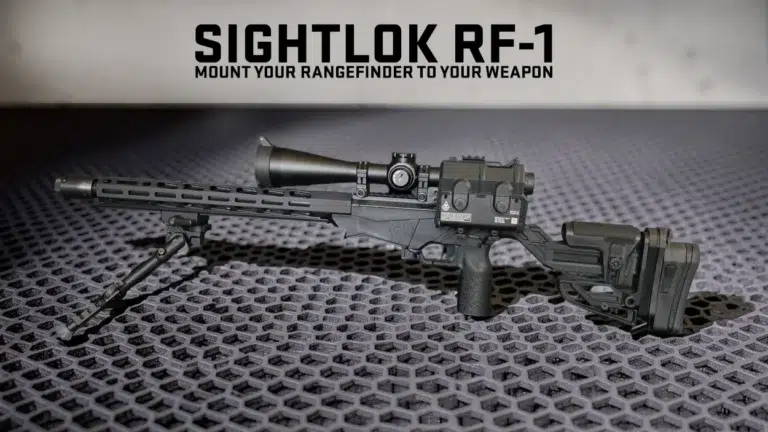
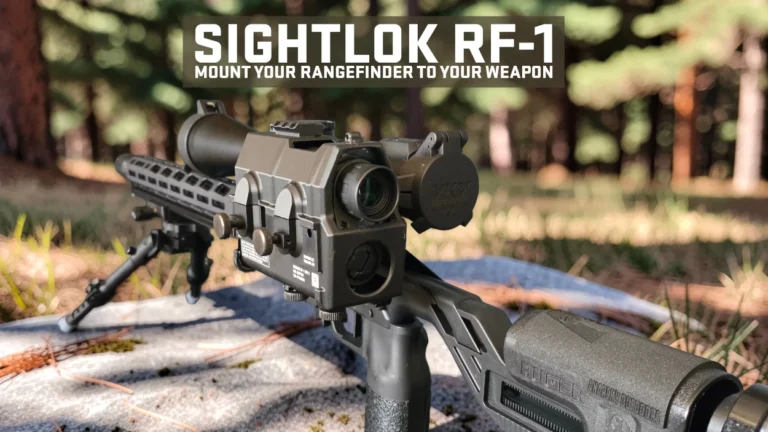
With the Sightlok RF-1, you can mount the handheld rangefinder you already own on your rifle’s rail and co-witness it to your scope.
Implications for the Competition
If it doesn’t suffer from major shortcomings, Sig Sauer’s new WMLRF KILO WARP rangefinder could kill off competitors like the Vortex Impact 4000 and the Tango Fire 4000, among others. Anyone considering the Vortex Impact 4000 or the Tango Fire 4000 would likely be putting buying decisions on hold to wait for Sig’s release.
WMLRF Goes Mainstream
But guys, seriously. The KILO WARP could be big. Sig’s KILO WARP could trigger a shift in the way rangefinding is done across shooting. Thousands more shooters will discover the amazing benefits of using a WMLRF. Shooters everywhere will be challenging the strength of their marriages as they try to squeeze an extra $2,000 out of their household budget.
4 Reasons You Might Want to Wait Before Impulse Buying the Sig KILO WARP Rangefinder
1. New WMLRFs Usually Have Bugs to Get Worked Out
The Vortex Impact 4000, for example, can stop working in cold weather. The Tango Fire 4000 can stop updating your firing solution in continuous ranging mode.
2. Sig Doesn’t Always Nail New Releases
Sig’s relatively recent and expensive ECHO SV35-LRF Thermal Sight, for example, has fatal flaws, including a built-in rangefinder which is not properly co-witnessed with the reticle and cannot be adjusted.
3. Concerns of Potential Bricking by Firmware Updates
Firmware bricking is a particularly irksome issue. Sig and their partner Applied Ballistics continue to force and enforce mandatory BDX firmware updates. Depending on the firmware version you’re currently running on your BDX rangefinder and/or BDX scope, Sig can detect that your firmware may be a little too old for their taste when you connect to the BDX app. When this happens, Sig remotely disables the rangefinder and/or scope until you have updated your firmware. Super annoying and Orwellian that they are doing this. And potentially dangerous for end users to have their rifle optics and rangefinders remotely disabled at the exact moment they may need to use them. Just imagine what a danger this alleged “feature” could be to soldiers on the battlefield. Certainly Sig wouldn’t do this with scopes and rangefinders they supply to law enforcement and the military.
And what’s worse, the updates don’t always complete as intended. Halfway through the update, the process can stop, leading to bricked hardware. People on forums like Snipershide talk about having to send back multiple BDX rangefinders on a semi-annual basis because they keep getting bricked by these mandatory firmware updates. Applied Ballistics is apparently partly (or perhaps even wholly) to blame for these firmware update glitches. We’ve covered this problem in detail in our reviews of other Sig BDX rangefinders. Our question for Sig is:
How many shooters are going to have their day at the range or their hunting trip disrupted before this problem is addressed?
And does the new Sig Sauer KILO WARP handle firmware updates in the same manner? We’ve spoken to high-level executives at both Sig Electro-Optics and Applied Ballistics about this issue and neither took the problem seriously. Neither saw it as a problem that needed addressing. The Sig executive, who shall go unnamed, tried to portray this as a benefit and a feature. “It’s better if you’re always using the latest version of the software.” Here is a link to a post on Snipershide with a BDX user who said he’s had his rangefinders bricked 3 times over the course of several years. To the best of our knowledge, this problem has not been resolved. We hope that everyone will join us being vocal about the issue until it gets addressed. Call Sig at 603-610-3000, or email your favorite Sig Sauer rep and tell them you’re not going to pony up $2K for a rangefinder or $6K for a rangefinder/scope combo they are remotely disabling when they feel like it, no matter what the excuse is.
4. Options That Cost Far Less, Including the Sightlok RF-1
An increasingly popular solution to the “WMLRF problem” is mounting a handheld rangefinder to your rifle using a Sightlok RF-1 rangefinder mount.
The approach has some disadvantages. Overall, however, it’s a more flexible, modular, and cost-effective solution that, depending on the rangefinder you deploy, can actually deliver more accurate results in the field.
The finished setup looks like this:
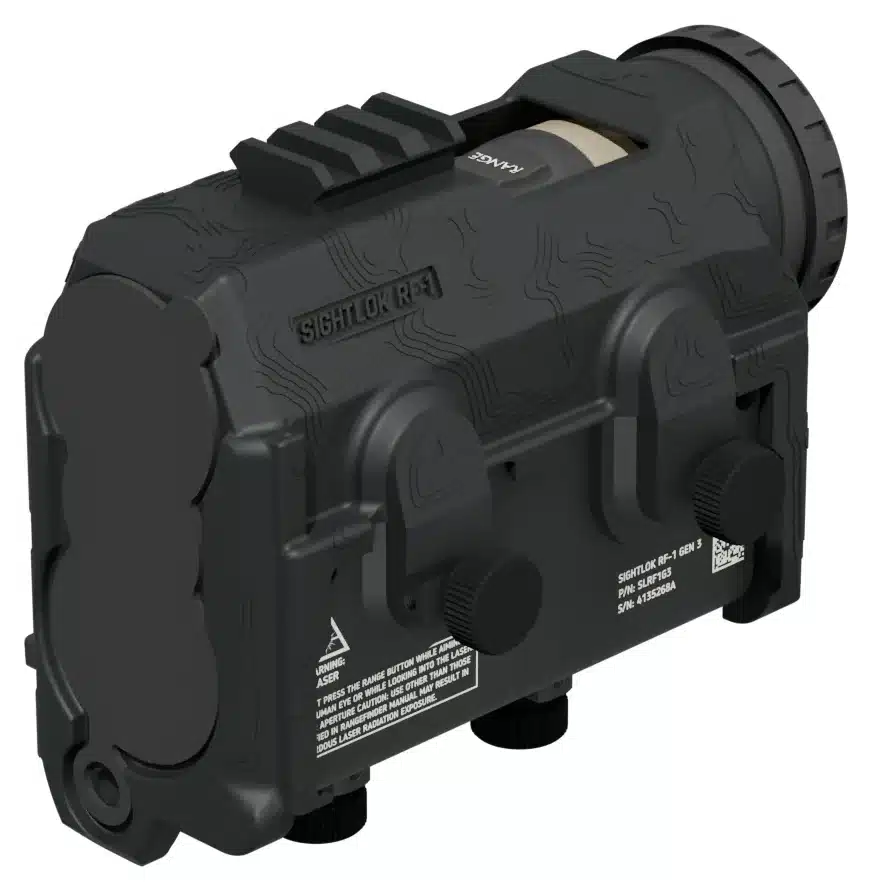
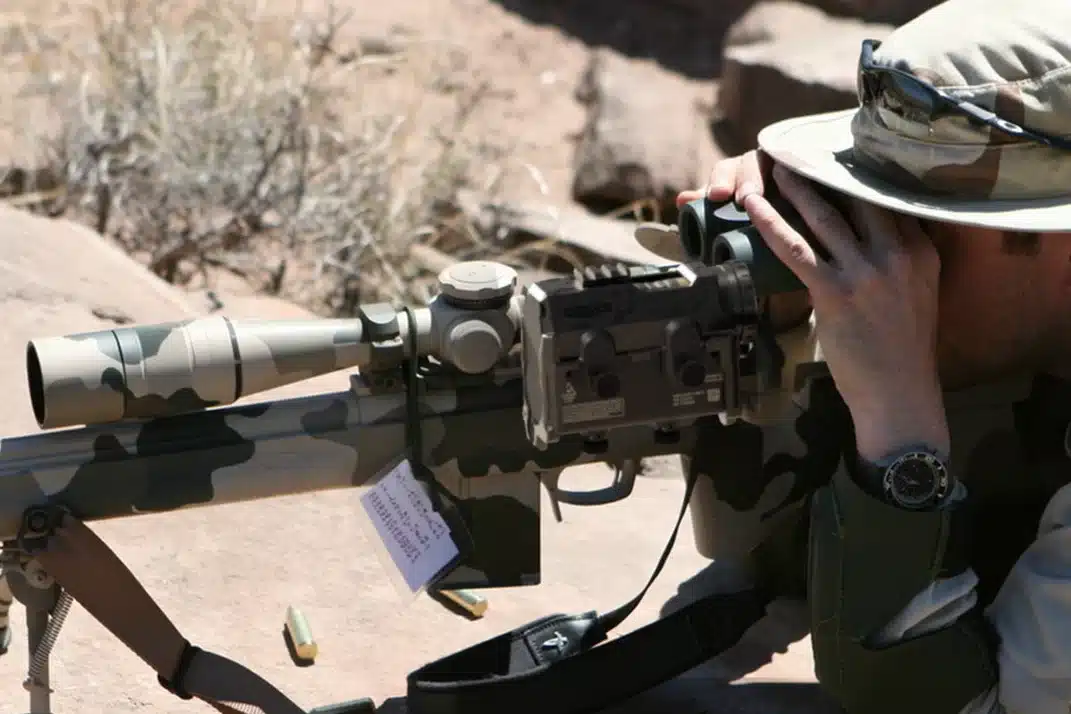
The Sightlok RF-1 protects your rangefinder from recoil, bumps, and scratches. A polymer hood protects the rangefinder as a whole, and hard rubber covers protect the laser aperture and eyepiece.
The Sightlok RF-1 setup may not look as slick as the KILO WARP, but functionally the two are similar. If you already own a rangefinder, you only buy the Sightlok RF-1, QD accessory and cover, $360 in all. A Sightlok RF-1 setup typically has no remote: you press the range button with your support hand.
We will continue to update this article as time allows.
Did we miss anything in this report?
Disagree with anything here?
We want to hear from you. Leave your feedback below.
Your comment appears right away. You don’t need to register or verify your email address.
Ready to Build a Better WMLRF?
Keep the rangefinder you already own, mount it on your rifle, and co-witness it to your scope.
 Try the Sightlok RF-1 for 30 days. If you don’t like it, send it back for a full refund, with no restocking fees, no return shipping fees and no questions.
New here?
Mount your rangefinder to your weapon
The Sightlok RF-1 is a Picatinny / Weaver rail mount that turns the handheld rangefinder you already own into a weapon-mounted laser rangefinder.