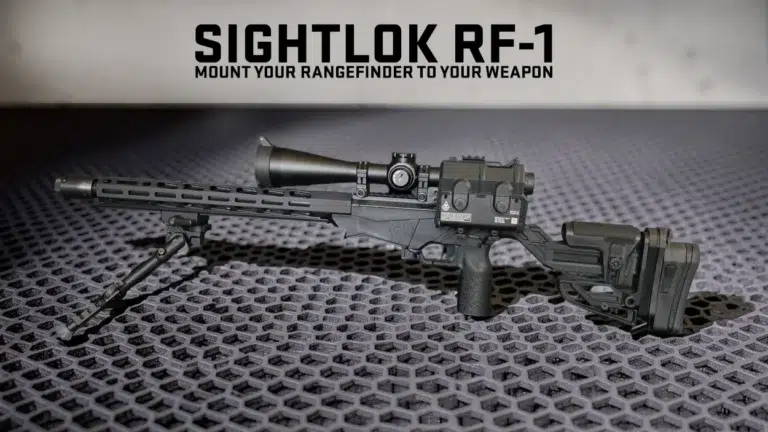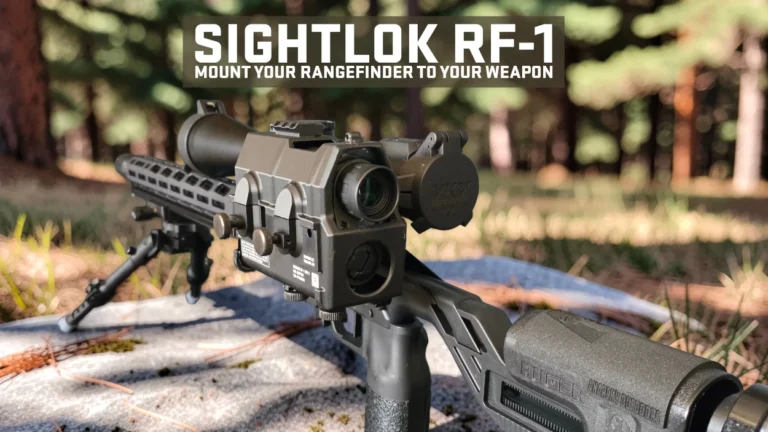
Q: Will recoil damage my rangefinder in a Sightlok RF-1?
A: Short answer: almost certainly not. We estimate the chance of one .308 shot damaging your rangefinder in the Sightlok RF-1 at about 1 in a billion. Below, we explain how we worked out that figure for cartridges from the .223 Remington to the .50 BMG.
To understand the probability of damage from recoil to your rangefinder, we must take into account how much force is being applied by common rifle cartridges like the .308, how that force is distributed, and roughly how close that comes to the amount of force necessary to actually damage your rangefinder.
Recoil killing a handheld rangefinder is an outdated notion. We worked out the recoil force, how the Sightlok RF-1 spreads that force, and how close that force comes to causing damage, for a rangefinder in the RF-1 and seven cartridges from the .223 Remington to the .50 BMG.
How much force?
The amount of force is not that great. For example, in the case of a .308, the cumulative force of the recoil is about equal to the force of you picking up your rangefinder and squeezing it hard for a few thousandths of a second.
The maximum average chamber pressure for the .308 Winchester is about 62,000 psi. Multiply 62,000 psi by the area of the bore, and the powder gas pushes the rifle back with about 4,600 pounds of force at the peak.
An 8.5-pound .308 hunting rifle with its scope speeds up at about 540 times the pull of gravity (540 g) at that peak. The whole recoil impulse, while the bullet travels down the barrel and the gas leaves the muzzle, lasts about 2 milliseconds.
Your rangefinder moves with the rifle, so your rangefinder speeds up at the same 540 g. A Sig KILO2200 takes a peak load of about 255 pounds of force. Averaged over the 2 milliseconds of recoil, the load on the Sig KILO2200 is about 72 pounds of force.
The table below gives the recoil energy, peak acceleration and peak force on the rangefinder for each cartridge, with a common factory load and a typical scoped rifle weight.
| Cartridge | Bullet (gr) | Velocity (fps) | Rifle with scope (lb) | Recoil energy (ft-lb) | Peak acceleration (g) | Peak force on a 7.5 oz rangefinder (lbf) |
|---|---|---|---|---|---|---|
| .223 Remington | 55 | 3,240 | 7.5 | 3 | 289 | 135 |
| 6.5 Creedmoor | 140 | 2,700 | 9 | 10 | 377 | 177 |
| .308 Winchester | 150 | 2,820 | 8.5 | 13 | 543 | 255 |
| .30-06 Springfield | 180 | 2,700 | 9 | 18 | 497 | 233 |
| .300 Winchester Magnum | 180 | 2,960 | 9 | 23 | 530 | 248 |
| .338 Lapua Magnum | 250 | 2,900 | 14 | 27 | 390 | 183 |
| .50 BMG | 660 | 2,750 | 30 | 79 | 373 | 175 |
The .300 Winchester Magnum sends about 7 times more recoil energy into your shoulder than the .223 Remington. The peak load on your rangefinder from the .300 Winchester Magnum is only about 1.8 times higher.
Recoil energy at your shoulder grows with bullet weight, bullet speed and powder charge, and drops as rifle weight goes up. Peak load on your rangefinder depends on peak chamber pressure, bore size and rifle weight. The seven cartridges in our list run at peak chamber pressures between 54,800 and 64,000 psi, so the peak load on your rangefinder changes far less from cartridge to cartridge than the recoil you feel.
A heavier rifle puts a lower peak load on your rangefinder. A 14-pound .338 Lapua Magnum rifle puts a lower peak load on your rangefinder than an 8.5-pound .308 hunting rifle. A 30-pound .50 BMG rifle puts an even lower peak load on your rangefinder.
How is the force distributed?
Beyond the actual amount of force is an even more critical factor: How the force is distributed. The Sightlok RF-1 uses 3M impact-absorbing rubber to hold the rangefinder and evenly distribute the recoil forces while simultaneously shielding sensitive areas like the buttons, the laser aperture lenses, the ocular, and the ocular lenses from impact. Lastly, when the rangefinder is held in the RF-1 mount, recoil force travels straight back along the bore axis, rather than to corners or edges where impact forces can cause more damage. The result of these mitigating factors is that recoil generates about the same amount of pressure on your rangefinder as you exert when you press the range button.
Pressure is force divided by the area that carries the force. We assumed the RF-1 rubber touches about 10 square inches of the rangefinder body. A peak of 255 pounds of force spread over 10 square inches comes to about 25 psi. For every cartridge in our list, the peak pressure on your rangefinder stays between 14 and 25 psi.
We estimate you press the range button with 2 to 3 pounds of force. We assumed the range button has about 0.08 square inches of surface, so your thumb puts about 25 to 38 psi on the button.
Typical standards for rangefinder durability
Handheld rangefinders are designed to survive drops of about 3 feet, and the impact from a 3-foot drop can generate several thousand psi of pressure.
A dropped rangefinder hits the floor at about 14 feet per second after a 3-foot fall. We assumed a hard floor stops the rangefinder within 1 to 2 millimeters, so the rangefinder slows down at about 460 to 910 g.
We assumed the falling rangefinder lands on one corner. We assumed the corner touches the floor over about 0.05 square inches. The rangefinder stopping at 460 to 910 g puts about 210 to 430 pounds of force through that patch, which comes to about 4,300 to 8,600 psi.
The peak force from .308 recoil falls inside the range of peak force from a 3-foot drop. The Sightlok RF-1 spreads the recoil force over about 200 times the area of the corner of a dropped rangefinder.
How close does recoil come to causing damage?
The RF-1 spreads recoil so evenly that no spot on your rangefinder takes more pressure than your thumb puts on the range button, a few dozen psi at most. A few dozen psi is well under 1% of the pressure your rangefinder is built to survive in a 3-foot drop. At that margin, the chance of a .308 shot damaging a healthy rangefinder in the RF-1 is effectively zero.
The table below compares the peak pressure on your rangefinder with the low end of the pressure from a 3-foot drop (4,300 psi), and gives our estimated chance of damage per shot.
| Cartridge | Peak pressure on the rangefinder (psi) | Share of 3-foot drop pressure | Estimated chance of damage per shot |
|---|---|---|---|
| .223 Remington | 14 | 0.3% | 1 in 90 billion |
| .50 BMG | 17 | 0.4% | 1 in 20 billion |
| 6.5 Creedmoor | 18 | 0.4% | 1 in 13 billion |
| .338 Lapua Magnum | 18 | 0.4% | 1 in 13 billion |
| .30-06 Springfield | 23 | 0.5% | 1 in 2 billion |
| .300 Winchester Magnum | 25 | 0.6% | 1 in 1 billion |
| .308 Winchester | 25 | 0.6% | 1 in 1 billion |
For the chance of damage, we set the middle value of a rangefinder’s damage threshold at 4,300 psi, a pressure a rangefinder is built to survive in a 3-foot drop. We assumed the damage threshold differs from one rangefinder to the next by a standard deviation as large as its average, and the recoil pressure differs from one shot to the next by a standard deviation of 20% of its average. We chose these wide spreads on purpose, so our estimate is more likely too high than too low.
A shooter who fires 1,000 rounds of .308 a year for 10 years has about a 1 in 100,000 chance of recoil damaging a healthy rangefinder in the RF-1. For this 10-year figure, we counted each shot as a separate chance of damage, so our figure is more likely too high than too low.
No reported failures
In two years of selling the Sightlok RF-1, no customer has reported a rangefinder damaged by recoil.
Recoil tests on video
Below, a US military rifleman tests the Sightlok RF-1 with recoil from two common cartridges.
Sig Sauer KILO1000BDX versus .308 rifle recoil:
Sig Sauer KILO1000BDX versus 6.5 Creedmoor rifle recoil:
The math behind our numbers
Are you a mathematician, physicist or engineer? Below you will find every formula we used, and a full walkthrough of the calculation for a 3-foot drop and for one cartridge, the .308 Winchester. We start with the drop, because the drop sets the pressure a rangefinder is built to survive. If you find an error or disagree with one of our assumptions, tell us in the comments below. If you are right, we will correct this article.
Formulas
Formula 1: Drop impact speed
Where g is 9.81 m/s² and h is the drop height.
Formula 2: Drop deceleration
Where s is the stopping distance (we assumed 1 to 2 mm). Dividing ad by 9.81 m/s² gives ad in g.
Formula 3: Drop contact pressure
Where ad is the drop deceleration in g and Acorner is the corner contact patch (we assumed 0.05 square inches).
Formula 4: Recoil momentum
Where mb is the bullet mass, vb the muzzle velocity, mc the powder charge mass and vg the powder gas speed at the muzzle (we used 4,000 fps).
Formula 5: Free recoil velocity
Where M is the mass of the rifle with its scope.
Formula 6: Recoil energy
Formula 7: Peak force on the rifle
Where Pmax is the maximum average chamber pressure and d the bore diameter.
Formula 8: Peak acceleration
Where W is the weight of the rifle with its scope in pounds; pounds of force divided by pounds of weight gives apeak in g.
Formula 9: Recoil impulse duration
Where L is the barrel length, 0.62 vb is our estimate of the average bullet speed in the barrel, and 1 ms covers the gas leaving the muzzle.
Formula 10: Average acceleration
Dividing ā by 9.81 m/s² gives ā in g.
Formula 11: Load on the rangefinder
Where Wrf is the rangefinder weight in pounds and a is the acceleration in g (peak or average).
Formula 12: Pressure on the rangefinder
Where Ac is the area the RF-1 rubber touches (we assumed 10 square inches).
Formula 13: Share of 3-foot drop pressure
Where 4,300 psi is the low end of the 3-foot drop pressure from Formula 3.
Formula 14: Lognormal spread
Where CoV is the coefficient of variation (standard deviation divided by the average).
Formula 15: Reliability index
Where S̃ is the middle value of the damage threshold (4,300 psi), σrf the middle value of the recoil pressure, ζS the lognormal spread of the damage threshold and ζL the lognormal spread of the recoil pressure.
Formula 16: Chance of damage per shot
Where Φ is the standard normal cumulative distribution function.
Formula 17: Chance of damage over N shots
Where N is the number of shots (10,000 for 1,000 rounds a year for 10 years).
Walkthrough: a 3-foot drop and the .308 Winchester
Inputs: a 3-foot (0.9144 m) drop onto a hard floor, a 150 gr bullet at 2,820 fps, a 44 gr powder charge, a 22-inch barrel, an 8.5 lb rifle with its scope, 62,000 psi maximum average chamber pressure, a 0.308-inch bore and a 7.5 oz (0.469 lb) rangefinder.
Step 1, using Formula 1 (drop impact speed):
Step 2, using Formula 2 (drop deceleration):
Step 3, using Formula 3 (drop contact pressure):
Step 4, using Formula 4 (recoil momentum):
Step 5, using Formula 5 (free recoil velocity):
Step 6, using Formula 6 (recoil energy):
Step 7, using Formula 7 (peak force on the rifle):
Step 8, using Formula 8 (peak acceleration):
Step 9, using Formula 9 (recoil impulse duration):
Step 10, using Formula 10 (average acceleration):
Step 11, using Formula 11 (load on the rangefinder):
Step 12, using Formula 12 (pressure on the rangefinder):
Step 13, using Formula 13 (share of 3-foot drop pressure):
Step 14, using Formula 14 (lognormal spread):
Step 15, using Formula 15 (reliability index):
Step 16, using Formula 16 (chance of damage per shot):
Step 17, using Formula 17 (chance of damage over N shots):
Assumptions
- We assumed the rifle recoils freely, with no muzzle brake. Your shoulder pushes against the rifle, so the loads on your rifle and rangefinder are lower than our figures.
- A heavier rangefinder takes a bigger recoil load and also hits the floor harder in a drop, so the share of drop pressure stays the same.
- We assumed the damage threshold differs from one rangefinder to the next with a coefficient of variation of 100%, and the recoil pressure differs from one shot to the next with a coefficient of variation of 20%.
New here?
Mount your rangefinder to your weapon
The Sightlok RF-1 is a Picatinny / Weaver rail mount that turns the handheld rangefinder you already own into a weapon-mounted laser rangefinder.