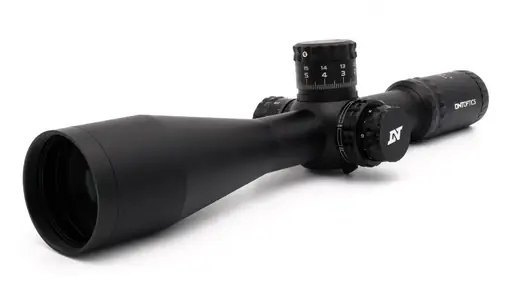
Q: Should I buy a DNT TheOne 7-35×56?
A: Short answer: Probably not. You cannot usefully shoot at 35X, and 7X is too much magnification for NRL22 and for the close targets in a PRS match, which are the competitions this scope is sold for. What’s left is a very heavy, very long scope that excels at nothing, and continues to propagate the myth to many shooters that more magnification somehow translates to better success in the field. A 7-35X range only makes sense if you’re shooting out to 3,000 yards — and if you’re shooting that far, you shouldn’t be buying a $600 optic. You want a March-FX 5-42×56 High Master or similar.
Q: What problems does the DNT TheOne 7-35×56 have?
A: The top 4 most critical issues of the DNT TheOne 7-35×56 are:
35X is not a usable setting — the image dims, the eyebox becomes unforgiving, and mirage ruins the picture on a warm day. More info here.
7X is too much magnification for PRS and NRL22 — NRL22 targets sit between 25 and 100 yards, and PRS stages include close targets shot against a clock. More info here.
It weighs nearly three pounds mounted and runs 16 inches long — weight that exists to support magnification you won’t use. More info here.
It may be the same scope as the Arken EP-5 — which would mean the value isn’t unique to DNT. More info here.
Q: What should I buy instead of the DNT TheOne 7-35×56?
A: If you’re shooting past a mile, a March-FX 5-42×56 High Master or a March Genesis 6-60×56. For PRS or NRL22, a scope with a lower minimum magnification — 4X or 5X. For hunting, a 1-6X or 1-8X LPVO. Our hunting scope recommendation is here.
👉 Read on for the exit pupil figures at 35X, why 7X is too much magnification for NRL22 and close PRS targets, and what to buy instead.
1. You Cannot Usefully Shoot at 35X
“7-35×56” for six hundred dollars is the pitch, and it works, because most buyers read a magnification range the way they read horsepower. Bigger number, more scope, better value.
Exit Pupil
Exit pupil is the diameter of the light cone the scope delivers to your eye. It is the objective lens diameter divided by the magnification. On a 56mm objective:
| Magnification | Exit pupil | Effect |
|---|---|---|
| 7X | 8.0mm | Wider than the human pupil opens. Forgiving eyebox. |
| 12X | 4.7mm | Comfortable. |
| 20X | 2.8mm | Head position starts to matter. |
| 35X | 1.6mm | Narrower than the human pupil in daylight. |
At 35X your eye has to sit in exactly the right position or the image blacks out partially or completely. The image is dimmer than at any lower magnification. Your pulse and your breathing both show up as movement in the sight picture.
Mirage
Magnification magnifies the air between you and the target as well as the target itself. On a warm day over open ground, mirage degrades the image at 35X long before the glass becomes the limiting factor.
This is why competitors at precision matches typically run 12X to 20X on scopes that go higher. The highest magnifications go unused.
What 35X Is Actually For
The product listing. It sells scopes to buyers comparing specifications who assume 35X must be better than 25X.
The DNT TheOne 7-35×56 would make an excellent telescope. The moon doesn’t move, doesn’t generate mirage, and doesn’t need to be found quickly.
Shooters Who Genuinely Need High Magnification
Some shooters do shoot at extreme distance. Watch the MarkandSam AfterWork channel and you’ll see steel hit at 2,000 and 3,000 meters. At those distances high magnification is necessary.
But if you’re shooting that far, a $600 optic is the wrong place to economize. You want a March-FX 5-42×56 High Master, built in Japan with mirage-resistant glass and 40 MIL of elevation travel, or for extreme long range the March Genesis 6-60×56, which cants the entire scope body so you always look through the center of the lens and provides 400 MOA of elevation.
Those scopes cost several times what the DNT costs. At 3,000 meters the optic is doing most of the work, and that’s where the money should go.
2. 7X Is Too Much Magnification for PRS and NRL22
DNT markets this scope for PRS, NRL22 and extreme long range. Here’s how 7X performs in the first two.
NRL22
NRL22 is a rimfire competition shot between roughly 25 and 100 yards. The lowest magnification available on this scope is 7X.
At 25 to 50 yards, 7X gives you a narrow field-of-view on a target you could see unaided, and you’re finding it against a clock. Most NRL22 shooters want a scope that goes down to 4X or 5X so they can acquire close targets quickly and still have enough magnification at 100 yards.
PRS
PRS stages regularly include targets inside 200 yards, transitions between multiple targets under time, and positional shooting off barricades. Those favor lower magnification and a wider field-of-view. 7X costs you time on them.
Hunting
This scope isn’t aimed at hunters, but for completeness: the average big game shot is around 140 yards, roughly 45% of animals are taken inside 100 yards, and a South Carolina DNR study of 603 shots found the shots that killed averaged 127 yards while the shots that missed averaged 150. At those distances you need to find the animal quickly, which requires field-of-view rather than magnification. Our full argument on hunting magnification is here.
Why Field-of-View Matters in Competition Too
Field-of-view isn’t only a hunting concern. It decides how quickly you can find a target and get on it, and in PRS and NRL22 that happens against a clock.
Field-of-view shrinks as magnification rises — doubling the magnification halves it. Going from 4X to 7X costs you close to half the picture. On a stage with several targets to engage in 90 seconds, shot off a barricade, that’s time spent finding steel instead of shooting it.
And the fix is the same one we argue for hunting: you don’t aim at low magnification, you find at low magnification. Drop to 1X, pick the target up instantly because the sight picture matches your naked eye, then zoom to 8X or 10X and break the shot. A scope that won’t go below 7X denies you the first half of that sequence.
For NRL22, where nothing is past 100 yards, an LPVO is the better tool outright. A 1-6X or 1-8X gives you an extremely wide field-of-view for finding close targets and more than enough magnification for the 100-yard stuff. Plenty of NRL22 shooters run one.
For PRS the limitation isn’t the technique, it’s the top end. LPVOs stop at 8X or 10X, and PRS stages past 1,000 yards want 12X to 20X. So the realistic answer for PRS is a scope whose lowest magnification is 3X to 5X rather than 7X — you keep the magnification you need for the long targets and recover field-of-view on the close ones.
7X Compared to Other Applications
| Application | Typical distance | Lowest magnification wanted |
|---|---|---|
| NRL22 | 25–100 yards | 4X or 5X |
| Big game hunting | ~140 yards | 1X |
| U.S. Army sniper optic | 725 yards | 5X |
| DNT TheOne 7-35×56 | — | 7X |
The lowest magnification on the DNT TheOne is higher than the lowest magnification on the U.S. Army’s sniper optic.
Ask yourself at what magnification you’ll take 90% of your shots. If the answer is between 10X and 18X, which it is for most shooters, you have paid for and are carrying a scope built around settings you won’t use.
3. Nearly Three Pounds, to Support Magnification You Won’t Use
The DNT TheOne 7-35×56 weighs 42 ounces and is 16 inches long. With rings or a one-piece mount you’re near three pounds. The included sunshade adds length.
That weight comes from the 56mm objective, the 34mm tube and the erector travel, all of which exist to support the magnification range. You carry it to enable settings you don’t use.
On a bench this doesn’t matter. Carried, it does.
4. It May Be the Same Scope as the Arken EP-5
Forum discussion has repeatedly noted that the DNT TheOne 7-35×56 closely resembles the Arken EP-5 7-35×56 — same configuration and layout, with differences in the reticle and the illumination. Several posters believe both come from the same manufacturer.
We can’t confirm it. But the sales pitch for this scope is value, and if the same factory supplies several brands, the value isn’t specific to DNT. Compare the reticle, illumination and warranty across those brands before buying.
What It Does Well
Between roughly 7X and 20X, reviewers consistently report the same strengths:
Strengths
- Japanese ED glass, clearer than most $600 scopes
- Turrets with crisp, audible clicks
- Working zero stop with a locking screw
- First focal plane, so holdovers are valid at any magnification
- Throw lever and sunshade included
What those strengths don’t fix
- Good glass doesn’t change the 1.6mm exit pupil at 35X
- Good turrets don’t lower the minimum magnification below 7X
- Neither helps you acquire a close target quickly
- Build quality doesn’t make 7-35X the right magnification range for PRS or NRL22
Who Should Buy the DNT TheOne 7-35×56?
| If you are… | Verdict |
|---|---|
| Shooting known-distance steel past 800 yards from a bench, above 15X | It will do the job |
| Shooting 3,000 yards, but unable to afford a March-FX 5-42×56 | This is your compromise |
| Shooting NRL22, targets 25 to 100 yards | 7X is too much magnification |
| Shooting PRS with close targets against a clock | Buy a scope that goes lower than 7X |
| Hunting | Buy a 1-6X LPVO |
| Carrying your rifle any distance | Too heavy for what it delivers |
| Studying the Milky Way | Go for it |
Whatever Scope You Choose, You Still Need a Range
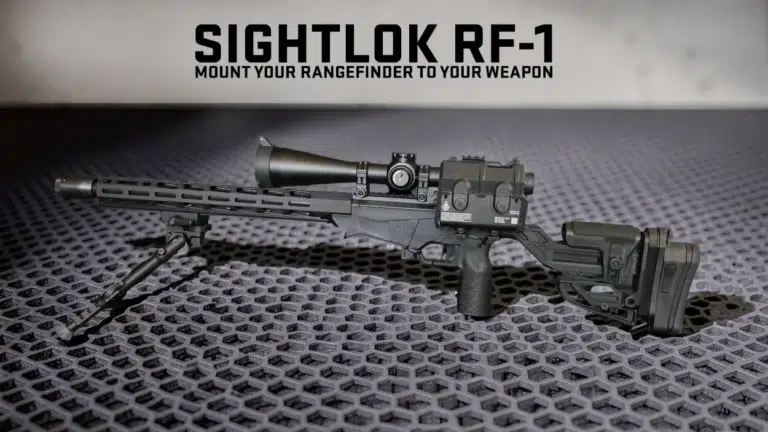
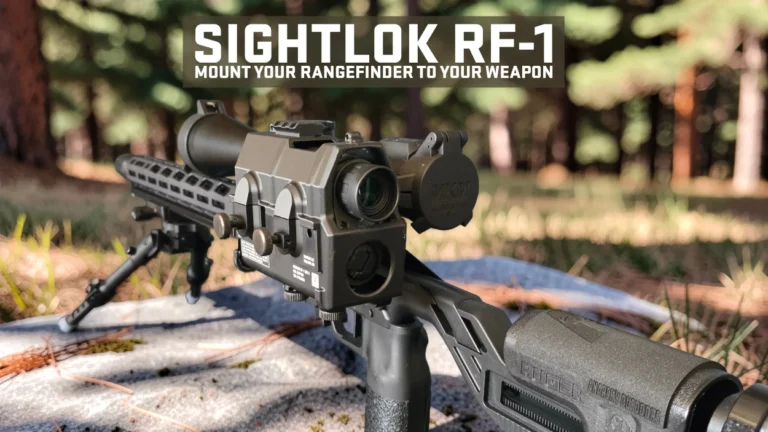
A scope tells you where to hold. It can’t tell you how far away the target is. The Sightlok RF-1 mounts a handheld rangefinder to your rifle, co-witnessed with your scope, so you range exactly where you’re aiming — and it comes off the rail in a second when you have a target you want to range that you don’t want to point your muzzle at.
Q: Is the DNT TheOne 7-35×56 any good?
A: Between roughly 7X and 20X, from a bench, at long known distances, it’s competently built, with good Japanese ED glass and turrets reviewers praise. Outside that, 35X is unusable in practice, 7X is too much magnification for NRL22 and close PRS targets, and it weighs nearly three pounds mounted.
Q: Can you really shoot at 35X on the DNT TheOne 7-35×56?
A: Not usefully. At 35X a 56mm objective gives a 1.6mm exit pupil, narrower than the human pupil in daylight, so the image dims and the eyebox becomes unforgiving. Magnification also magnifies mirage, which degrades the image on a warm day before the glass becomes the limiting factor. Competitors typically run 12X to 20X.
Q: Is the DNT TheOne 7-35×56 good for NRL22?
A: No. NRL22 targets sit between 25 and 100 yards and 7X is the lowest magnification this scope offers. Most NRL22 shooters want 4X or 5X available so they can acquire close targets quickly.
Q: Is the DNT TheOne 7-35×56 good for hunting?
A: No. Its lowest magnification is 7X, which is higher than the lowest magnification on a U.S. Army sniper optic. The average big game shot is around 140 yards, where you need field-of-view to find the animal quickly.
Q: How much does the DNT TheOne 7-35×56 cost?
A: MSRP is $699.99. Street pricing has been around $599.99.
Q: How heavy is the DNT TheOne 7-35×56?
A: 42 ounces and 16 inches long. With rings or a one-piece mount, close to three pounds.
Q: Where is the DNT TheOne 7-35×56 made?
A: China. DNT labels it as such on the scope body. The glass is Japanese ED.
Q: What should I buy instead of the DNT TheOne 7-35×56 for hunting?
A: A 1-6X or 1-8X LPVO. Our pick is the Sig Sauer EASY6-BDX 1-6X: true 1X for fast target acquisition, 6X for the shot, and BDX support so a paired rangefinder puts an illuminated holdover dot in your reticle. Full reasoning here.
Who is Sightlok?
Sightlok publishes 100% factual, unbiased reports and reviews on electro-optics gear, with a particular focus on weapon-mounted laser rangefinders (WMLRF). Sightlok is the world’s leading independent expert on the various WMLRF options currently available. Sightlok is also the engineering and manufacturing team behind the highly-regarded Sightlok RF-1. If we can help someone find a product which perfectly meets their needs, or avoid a product which is less-than-ideal, our efforts were not in vain.
Where is this information sourced from?
The information is sourced from our own experiences with products in the field, and from customers we communicate with in the course of doing business, and from respected members posting on forums like Snipershide, Rokslide, and LongRangeHunting.
Did we miss anything in this report?
Disagree with anything we had to say?
Your opinion is precious, we would love to hear your feedback.
Any comments you leave below are published instantly, there’s no need to register before posting or verify your email address.
Ready to Complete Your Setup?
Mount the rangefinder you already own to your rifle, co-witnessed with your scope.
New here?
Mount your rangefinder to your weapon
The Sightlok RF-1 is a Picatinny / Weaver rail mount that turns the handheld rangefinder you already own into a weapon-mounted laser rangefinder.