
Q: What is the best scope for hunting?
A: For nearly every big game hunter in North America — deer, elk, bear, wild boar — a 1-6X or 1-8X LPVO is the best scope for hunting. Our specific pick is the Sig Sauer EASY6-BDX 1-6X. If your first reaction is “I need more magnification than that,” this article is written for you, because that belief is costing hunters animals every single season.
Q: Why does choosing the right magnification range for your scope matter so much?
A: Because the step that decides most hunts isn’t aiming — it’s finding the animal inside your scope after you’ve spotted it with your naked eye. Every increase in magnification shrinks your field-of-view and makes that step slower. Get it wrong and the animal is gone before you ever had a sight picture.
Q: What are the most common mistakes hunters make when choosing a scope?
A: Five of them:
Buying for a distance they’ll never shoot — the scope is specced for 800 yards on a rifle and a quarry that realistically max out around 400. More info here.
Believing extra magnification is free — it isn’t, and it costs you in six separate ways every time you raise the rifle. More info here.
Giving up 1X at the bottom of the range — which throws away instant target acquisition and the ability to shoot with both eyes open. More info here.
Spending on glass quality before getting the magnification right — the finest glass in the world can’t help you shoot an animal you can’t find in the scope. More info here.
Not considering a “smart” LRF + scope combo — a system like Sig Sauer BDX eliminates the steps of dialing dope or working out a reticle holdover. More info here.
Q: So what should I actually buy?
A: A 1-6X or 1-8X LPVO, ideally one that can receive a firing solution from your rangefinder. We recommend the Sig Sauer EASY6-BDX 1-6X, at about $1,000. In the Sig BDX system the ballistic solver lives in the rangefinder, not the scope — the rangefinder does the math and sends the scope an illuminated holdover dot over Bluetooth. Pair it with a BDX rangefinder and a Sightlok RF-1 mount and you have a complete ranging and ballistics setup on the rifle. Full reasoning below.
👉 Read on for the math, the military references, and the six specific ways too much magnification works against you.
Or jump straight to an answer: What magnification do I need? · Is an LPVO enough gun scope? · Why does 1X matter? · Glass quality or magnification? · What do you recommend? · See all FAQs
The Internet is Getting it Wrong
Ask the internet what the best hunting scope is and you’ll get a confident answer from a thousand people who have never thought about the question properly. The top-upvoted recommendation on Reddit for a hunting optic is a Leupold VX-3 3.5-10×40. It’s a well-made scope. It’s also the wrong magnification range for the job, and this article is going to show you why using arithmetic, the doctrine of the people who shoot for a living, and the way a hunt actually unfolds.
A warning before we start: most of you will disagree with the first paragraph of the next section. Read to the end anyway.
1. Buying For a Distance You Will Never Shoot
The right way to choose a magnification range is to start with one question: at what distance will I actually be shooting? Not the distance you imagine. The distance the statistics say.
The Average Big Game Shot Is Around 130 to 145 Yards
| Source | What it measured | Result |
|---|---|---|
| South Carolina DNR | 603 shots taken at deer, 493 harvested | 132 yards mean |
| Hunter-compiled data set | Median distance by species | Whitetail 135, mule deer 150, elk 168 |
| Realtree (Richard Mann) | 64 big game animals across 5 countries, 11 states | 143 yards overall, 102 for whitetail |
Three sources, all clustered between roughly 130 and 145 yards. Call it 140 yards as a working figure for big game.
The South Carolina study contains one more detail worth your attention. Shots that resulted in a dead deer averaged 127 yards. Shots that missed averaged 150 yards. The further out hunters reached, the more often they came home with nothing — which is this entire article in one sentence.
And the distribution matters as much as the average. Roughly 45% of big game is taken inside 100 yards, and in wooded and eastern-state country the typical shot is closer to 50–75 yards — the distance across a large room. Meanwhile the vast majority of successful hunts happen well inside 300 yards. Past that you’re far more likely to miss, to take an unethical shot, or to fail to recover the animal. Field & Stream’s own testing found that even the best hunters with the best equipment had more misses than hits at 400 yards.
Your Cartridge Has a Ceiling Too
There’s a second limit most hunters never calculate. Your maximum ethical hunting distance is roughly the point where your bullet slows to 1,900 feet per second. Below that speed the bullet can fail to expand, and a bullet that doesn’t expand wounds rather than kills. It varies by caliber and bullet design, but as a general rule, that’s the line.
For .308 Winchester, the bullet drops below 1,900 FPS at about 400 yards. So 400 yards isn’t a stretch goal for a .308 hunter — it’s a hard ceiling imposed by terminal ballistics.
Put those two facts together and the conclusion is uncomfortable: it makes no sense to put a scope good for 800 yards on a rifle with an ethical ceiling of 400.
What the Military Chooses, and What That Implies for You
If you won’t take our word for the magnification range, take the word of the experts in the US military, who know a heck of a lot more about this topic than practically anyone else.
Military snipers in combat typically engage between 300 and 1,300 yards, with most engagements falling between 550 and 900 — call it an average engagement distance of 725 yards. The U.S. Army’s standard sniper optic for that work is the Mark 5HD 5-25×56.
Now run the ratio. Big game is taken at an average of roughly 140 yards:
140 ÷ 725 = 19%
A hunter is shooting less than a fifth of the distance a military sniper is. So scale the optic accordingly:
| Military sniper | Hunter (a fifth the distance) | |
|---|---|---|
| Typical engagement | 725 yards | 140 yards |
| Bottom of magnification range | 5X | 0.97X |
| Top of magnification range | 25X | 4.8X |
The math says a hunter’s scope should bottom out at 1X and top out at about 5X. A 1-6X LPVO covers that with room to spare. The same answer we reached from the distance data, arrived at from a completely different direction.
There’s a third piece of evidence pointing the same way. When Richard Mann recorded the scope magnification actually being used at the moment each of those 64 animals was shot, the average came out at 6X — and that includes hunters carrying scopes that went to 16X and beyond. Given the choice, in the field, at the moment of truth, hunters dial down to roughly 6X anyway.
2. Believing Extra Magnification Is Free
Here is the belief at the center of this whole problem: having extra magnification never hurt anyone.
It isn’t true. We’d guess that every day in North America, hunters go home empty-handed because the magnification range on their scope is too high — and they have no idea that’s what sank the hunt. They’ll blame the wind, the animal, their luck.
Six Ways Excessive Magnification Works Against You
| # | What you lose |
|---|---|
| 1 | 1X, and everything that comes with it — instant target acquisition, both eyes open, situational awareness |
| 2 | Field-of-view — halved at 2X, quartered at 4X, and it’s the thing that decides whether you find the animal |
| 3 | Light transmission — which matters most in exactly the low-light conditions where game moves |
| 4 | Exit pupil — a smaller one means a tighter, less forgiving eyebox and more time spent hunting for a clean sight picture |
| 5 | Optical performance — more magnification means more glass elements, and every element costs you something |
| 6 | Weight and money — you’re carrying more and paying more for a capability you’ll never use |
Not one of those is a theoretical concern. Every one of them shows up on the hill.
Already Have the Right Scope? There’s One More Piece.
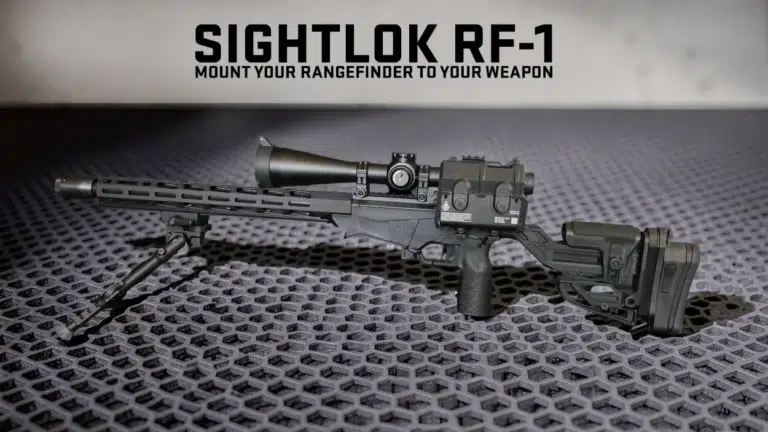
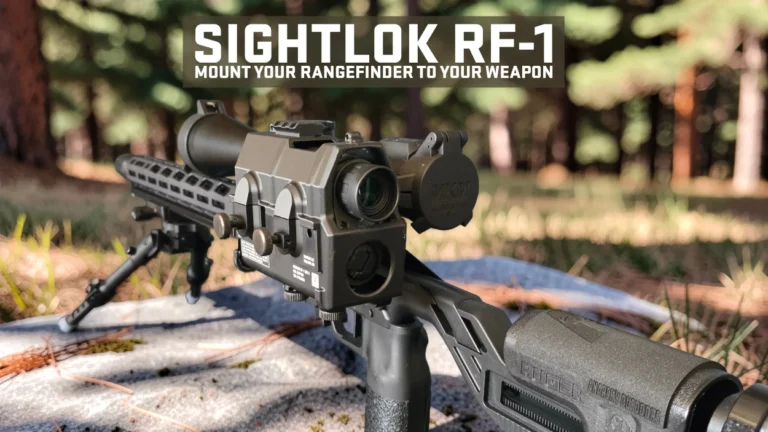
A scope tells you where to hold. It can’t tell you how far away the animal is. The Sightlok RF-1 mounts a handheld rangefinder to your rifle, co-witnessed with your scope, so you range exactly where you’re aiming.
3. Giving Up 1X at the Bottom of the Range
To understand why the bottom number on your scope matters more than the top one, walk through what actually happens on a hunt.
The Five Steps of a Successful Hunt
| Step | What happens |
|---|---|
| 1 | You see the animal — with your naked eyes |
| 2 | You range it |
| 3 | You dial your dope |
| 4 | You acquire the animal inside your scope |
| 5 | You take the shot |
Step 4 is where hunts die, and it’s the step nobody optimizes for.
Your Eyes Are 1X
You don’t walk the woods with a scope pressed to your face looking for deer. You first spot your deer with your bare eyes. Your bare eyes are 1X. If 3X was better for spotting your prey, God would have given you 3X eyesight.
Now the clock starts. You have to get from “I can see it” to “I can see it through the scope” before your dinner walks off. And the fastest way to do that is for the view through the scope to match the view you already have.
At 1X, the sight picture through the scope is identical to your natural vision. The transition time is effectively zero. Once the animal is in the scope, you dial up to 4X, 6X, whatever you need, and shoot.
What Happens When Your Scope Starts at 2X
Your field-of-view through the scope is now half what it was. You’re seeing half as much, and you’re hunting for the animal by waving the rifle around. At 4X you’re down to a quarter of the view, and finding the animal is four times harder.
You can spend a genuinely absurd amount of time swinging a rifle around trying to get an animal you can plainly see with your naked eye to appear somewhere inside your scope. And that is the worst possible moment for it, because fast acquisition is exactly what separates a full freezer from an empty one.
“But 1X Isn’t Enough Magnification to Shoot Accurately”
This is the most common objection and it’s a misunderstanding. Nobody is telling you to take the shot at 1X. We’re saying the transition from naked eye to scope is fastest when the scope is dialed to 1X. Once you’ve got the animal in the glass, dial up to whatever magnification you need for the shot. You lose nothing.
Both Eyes Open
There’s one more thing you only get at 1X: you can shoot with both eyes open. One eye through the scope, the other taking in the scene directly. Vastly wider awareness of what’s happening around the animal. You give that up entirely the moment your scope’s bottom end is 2X or higher.
4. Buying Glass Quality Before Getting Magnification Right
Plenty of people will tell you to buy the best glass you can afford. Tangent Theta. Schmidt & Bender. It’s not bad advice — it’s just second-order advice being given first.
The 3-Gun Test
3-Gun matches involve moving between positions and engaging targets at short to medium range. On one point every competitor agrees: you run irons or a 1X optic. Nobody argues a 2-6X would be better. Suggesting it would be taken as a joke, because at any magnification you’d be stumbling around waving your rifle trying to find targets.
Now the question that settles the glass debate. In a 3-Gun match, would you rather have:
| Option A | Option B |
|---|---|
| A 1X Tasco | A 3-12X Schmidt & Bender |
Everyone picks the Tasco. Not close. With five thousand dollars of optically perfect German glass you’d still be flailing, unable to find your targets.
Which proves the point: choosing the correct magnification matters more than having the world’s best glass. Glass quality is worth paying for — after you’ve got the magnification range right, not before.
5. Not Considering a “Smart” LRF + Scope Combo
Get the magnification right and you’ve solved step 4. But steps 2 and 3 — ranging the animal and dialing your dope — are still sitting there costing you time.
The traditional process is: range the animal, consult your dope card, dial your elevation turret, or work out the right holdover on the reticle. That’s a lot to do while something with legs decides whether to stay put.
This is where the last decade has quietly changed things, and where most buying advice hasn’t caught up. In Sig Sauer’s BDX system the ballistic solver sits in the rangefinder, not the scope: the rangefinder measures the distance, reads its onboard environmental sensors, solves the firing solution, and sends it to the scope over Bluetooth, where it appears as an illuminated holdover dot at the correct elevation. No card, no turret, no arithmetic.
That’s worth being precise about, because it changes what you’re shopping for. The scope’s job is to display the solution. The rangefinder’s job is to calculate it. Which means the rangefinder you pair with the scope matters just as much as the scope itself.
That’s why our specific recommendation isn’t just any LPVO.
Our Pick: The Sig Sauer EASY6-BDX 1-6X
At about $1,000, the EASY6-BDX 1-6X does everything this article argues for:
| Requirement | EASY6-BDX 1-6X |
|---|---|
| True 1X at the bottom | Yes — instant acquisition, both eyes open |
| Enough magnification for the distances you’ll shoot | 6X, comfortably past the ethical ceiling of most hunting cartridges |
| Wide field-of-view | 106 feet at 100 yards at 1X |
| Ballistic assistance | BDX-enabled — displays the illuminated holdover dot your BDX rangefinder calculates and sends it |
If you want a little more reach at the top, a 1-8X follows the same logic. What you should not do is buy something that starts at 2X, 3X or 4X.
Completing the System
The EASY6-BDX gets its holdover dot from a rangefinder — the rangefinder is where the ballistic solver actually lives. Which raises the obvious question: where is the rangefinder while you’re behind the rifle?
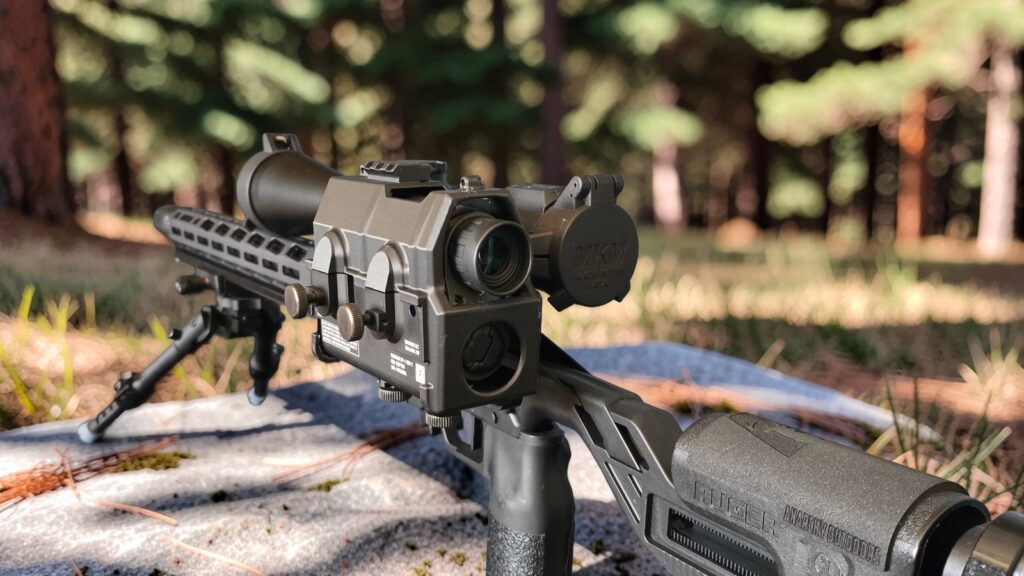
If the answer is “in my pack” or “in my pocket,” you’ve reintroduced the delay you just spent a thousand dollars eliminating. The Sightlok RF-1 mounts your Sig BDX rangefinder to the rifle, co-witnessed with the scope, so it ranges exactly where you’re aiming. It also comes off the rail with a lever when you want to range a target without pointing your muzzle at it.
The Complete Hunting Setup
- A 1-6X LPVO — true 1X for instant acquisition, 6X for the shot
- A Sig BDX rangefinder — it holds the ballistic solver and sends the holdover dot to the scope, so it has to be a BDX unit for this setup to work
- A Sightlok RF-1 mount — $250, puts the rangefinder on the rifle, co-witnessed with the scope
- Range where you aim, then snap the rangefinder off the rail when you don’t want to point your muzzle at what you’re ranging
Okay, What Are the Downsides of Choosing the Sig?
We’ve spent this whole article making a case, so it’s only fair to put the other side of it. There are two real arguments against the BDX route, and if either one matters enough to you, you should buy something else.
1. You’re Dependent on Electronics That Can Fail
A BDX setup is a system, and every part of it can quit on you. The scope needs battery power to illuminate the holdover dot. The rangefinder needs battery power to range and to solve. The Bluetooth link between them has to connect and stay connected. And all of that has to work in cold, wet, dusty conditions, often after being knocked around in a truck and a pack for a week.
Electronics fail more often than a traditional scope does — that’s just true, and pretending otherwise would be dishonest. A fixed reticle in a mechanical scope has no battery, no firmware, no pairing step and nothing to fall out of sync. It works the ten thousandth time exactly as it worked the first.
That doesn’t mean BDX is unreliable, but it does mean the failure modes are different. A dead battery or a dropped connection at the wrong moment leaves you holding a scope with no dot in it, and if you’ve never practiced dialing dope the traditional way, you’re in trouble. Carry spare batteries, check the pairing before you hunt, and know your come-ups well enough to shoot without the electronics.
2. The Glass Isn’t Schmidt & Bender Glass
Earlier we argued that magnification range matters more than glass quality, and we stand by that. But “more important” isn’t “the only thing that matters,” and it would be a cheat to use that argument to pretend the glass question disappears.
The optical quality in the Sig BDX scopes is not at the level of a Schmidt & Bender, a Tangent Theta, or the other top-tier European glass. That shows up in edge-to-edge sharpness, in contrast, in how the image holds together in the last few minutes of legal light. And low light is exactly when a lot of game moves, so this is not a trivial difference. It’s real, and it’s worth being honest about.
What we’d say is that it’s a trade, not a defect: you’re exchanging some optical quality for a ranging and ballistic system that removes two steps from the shot process. For most hunters, at the distances they actually shoot, that’s a trade worth making. For some, it won’t be.
Why You Might Still Want a Traditional Scope and Manual Dope
Here’s a case we take seriously. Suppose you’re genuinely concerned about your gear in a SHTF scenario. You might well run a Sig as your primary setup and still want a fallback optic — something with no batteries and no pairing, that you’ve practiced dialing on and can shoot accurately with under pressure.
That’s a sound way to think about it. Technology that gives you greater speed is great, but in an emergency, reliability matters more than speed. If reliability means more to you than shooting accurately quickly, then by all means, buy a Schmidt & Bender or a similar LPVO and master it.
Just apply the same magnification logic when you do. A traditional scope with the wrong magnification range is still the wrong scope — the argument in this article is about magnification first, electronics second.
Q: What magnification do I need on a hunting scope?
A: For big game in North America, 1-6X or 1-8X. Independent data sets put the average big game shot between roughly 130 and 145 yards, and about 45% of animals are taken inside 100 yards. Scaling from what military snipers use at their typical 725-yard engagement distance puts a hunter at roughly 1-5X. Anything starting at 3X or 4X is specced for distances you will not be shooting.
Q: Is an LPVO really enough scope for deer, elk or bear?
A: Yes, comfortably. 6X is plenty of magnification to place a shot accurately at 400 yards, and 400 yards is beyond the ethical ceiling of most hunting cartridges anyway — a .308 bullet drops below the 1,900 FPS expansion threshold at about that distance. You are not giving up any capability you could ethically use.
Q: Why does having true 1X matter so much?
A: Because at 1X the sight picture through your scope is identical to your naked eye, so moving from “I see the animal” to “I see the animal in my scope” takes no time. At 2X your field-of-view is halved and that transition gets noticeably harder; at 4X it’s quartered. 1X is also the only setting where you can shoot with both eyes open.
Q: Don’t I need high magnification to shoot accurately?
A: You need enough magnification at the moment of the shot — and nobody is suggesting you shoot at 1X. Find the animal at 1X, then dial up to 4X or 6X and take the shot. You get fast acquisition and an accurate sight picture. A scope that starts at 3X gives you only the second half of that.
Q: Should I prioritize glass quality or magnification range?
A: Magnification range, every time. In a 3-Gun match a 1X Tasco will beat a 3-12X Schmidt & Bender, because no amount of optical quality helps you shoot a target you can’t locate in the scope. Buy the best glass you can afford — within the correct magnification range, not instead of it.
Q: What’s wrong with the Leupold VX-3 3.5-10×40 everyone recommends?
A: Nothing is wrong with how it’s built. What’s wrong is the magnification range for this job. Starting at 3.5X means you’ve given up 1X acquisition and both-eyes-open shooting, and you’re working with roughly a quarter of the field-of-view you could have had, in exchange for top-end magnification suited to distances past the ethical range of most hunting cartridges.
Q: How far can I ethically shoot a deer?
A: As a general rule, out to the point where your bullet slows to about 1,900 feet per second — below that it may not expand reliably, which wounds rather than kills. For .308 Winchester that’s roughly 400 yards. The exact figure varies by caliber and bullet design, so check yours. The relevant point for scope selection is that this ceiling is far closer than most people’s magnification suggests.
Q: What scope do you recommend for hunting?
A: The Sig Sauer EASY6-BDX 1-6X, at about $1,000. True 1X at the bottom, 6X at the top, a wide field-of-view, and BDX support so a paired rangefinder puts an illuminated holdover dot in your reticle. Worth knowing how the system actually works: the ballistic solver is in the BDX rangefinder, not the scope — the rangefinder calculates the solution and the scope displays it. So pair it with a BDX rangefinder, add a Sightlok RF-1 mount, and the ranging, the ballistics and the aiming all happen without you coming off the rifle.
Q: I already own a high-magnification scope. Do I have to replace it?
A: Not necessarily — but know what it’s costing you, and hunt accordingly. Keep it dialed to its lowest setting while you’re moving and glassing, so you have the widest field-of-view available when an animal appears, and only dial up once it’s in the scope. That habit recovers some of what the magnification range took away. When it’s time to replace the optic, buy the range that matches the distance you actually shoot.
Who is Sightlok?
Sightlok publishes 100% factual, unbiased reports and reviews on electro-optics gear, with a particular focus on weapon-mounted laser rangefinders (WMLRF). Sightlok is the world’s leading independent expert on the various WMLRF options currently available. Sightlok is also the engineering and manufacturing team behind the highly-regarded Sightlok RF-1. If we can help someone find a product which perfectly meets their needs, or avoid a product which is less-than-ideal, our efforts were not in vain.
Where is this information sourced from?
The information is sourced from our own experiences with products in the field, and from customers we communicate with in the course of doing business, and from respected members posting on forums like Snipershide, Rokslide, and LongRangeHunting.
Did we miss anything in this report?
Disagree with anything we had to say?
Your opinion is precious, we would love to hear your feedback.
Any comments you leave below are published instantly, there’s no need to register before posting or verify your email address.
Ready to Complete Your Hunting Setup?
Mount the rangefinder you already own to your rifle, co-witnessed with your scope — and take it off the rail in a second when you need to.
New here?
Mount your rangefinder to your weapon
The Sightlok RF-1 is a Picatinny / Weaver rail mount that turns the handheld rangefinder you already own into a weapon-mounted laser rangefinder.