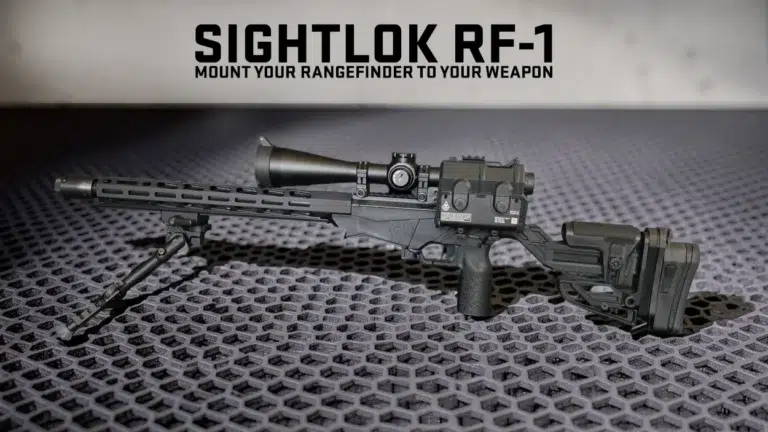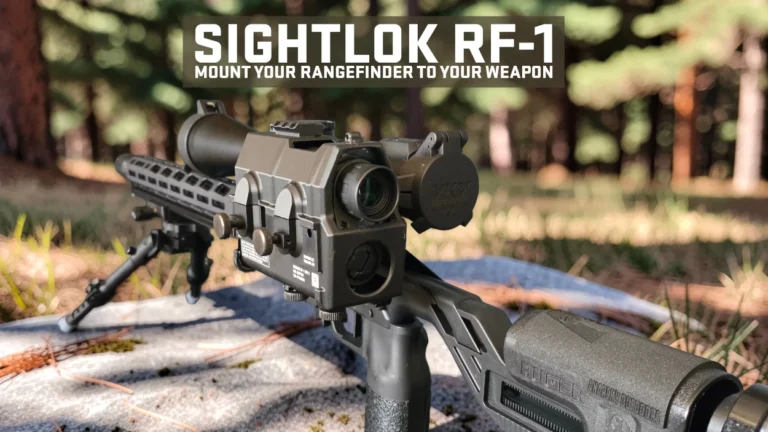
These are 8 advantages of a weapon-mounted laser rangefinder (WMLRF) over a handheld rangefinder you hold in your hand:
1. Faster ranging
Hunting opportunities are often fleeting. With a weapon-mounted laser rangefinder, you range the target without taking your eye off it. Instead of fumbling with a handheld rangefinder, you aim and range at the same time, so you have a better chance of taking the shot before the animal moves.
2. More accurate ranging due to better optics and greater stability
You range through the superior optics of your scope instead of the rangefinder’s optics, so you are less likely to take an ill-advised shot that wounds an animal instead of killing it cleanly. You also hold a riflescope steadier than a handheld rangefinder, so you range more accurately.
3. Scope and rangefinder operate as a single unit
When you co-witness the rangefinder with the scope, the scope and rangefinder work as one electro-optical sensor.
4. Fast view switching between rangefinder and scope
5. Faster firing solutions
6. Increased first-round hit potential
7. Greater adaptability
Many weapon-mounted laser rangefinders have modes for different shooting conditions, such as bright sunlight or low light. Many also have built-in ballistic calculators that you set up for your ammunition, so they account for bullet drop and windage on long-range shots.
8. Integration with other technologies
Weapon-mounted laser rangefinders can connect to other devices, such as scopes and smartphones. The Sig Sauer BDX platform is an excellent example. Some rangefinders have Bluetooth, so you can sync data with your phone for further analysis and adjustments.
Turn Your Handheld Into a Better WMLRF
With the Sightlok RF-1, you can quickly detach the RF-1 from the rail when you want to range a target you don’t want to point your muzzle at, and reattach when you’re done, while maintaining an accurate co-witness between your rangefinder and scope.
See how to turn the rangefinder you already own into a better WMLRF
WMLRF options
You can buy a dedicated WMLRF, but mounting the handheld rangefinder you already own in a Sightlok RF-1 mount costs less and can be more accurate. The finished setup looks like this:
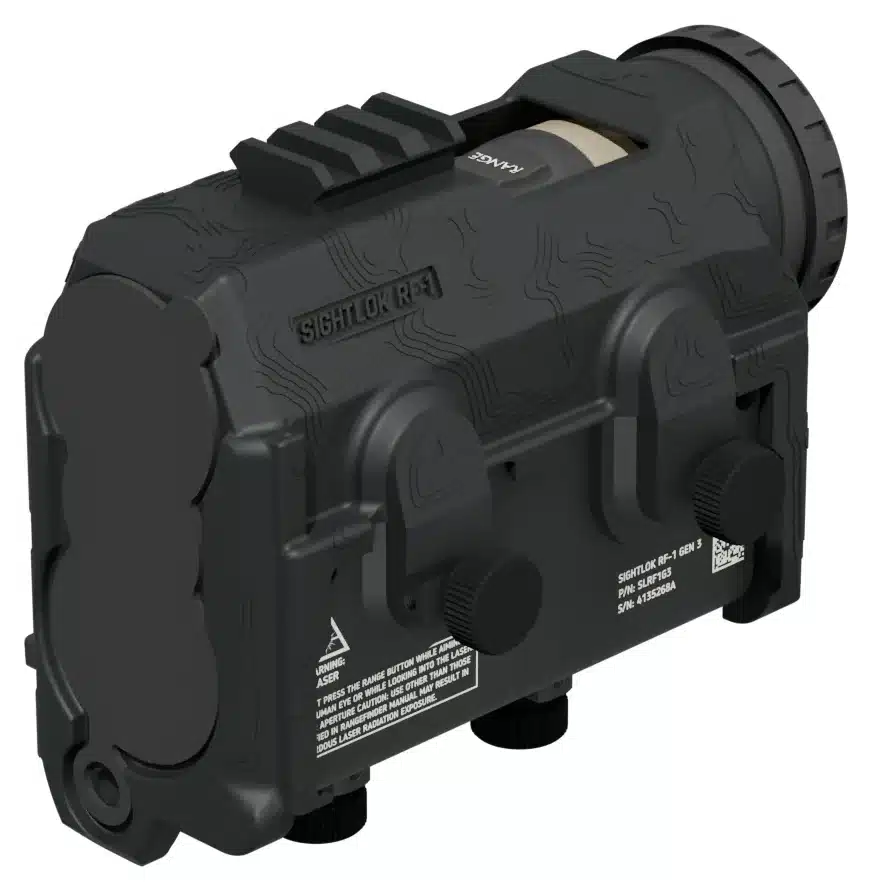
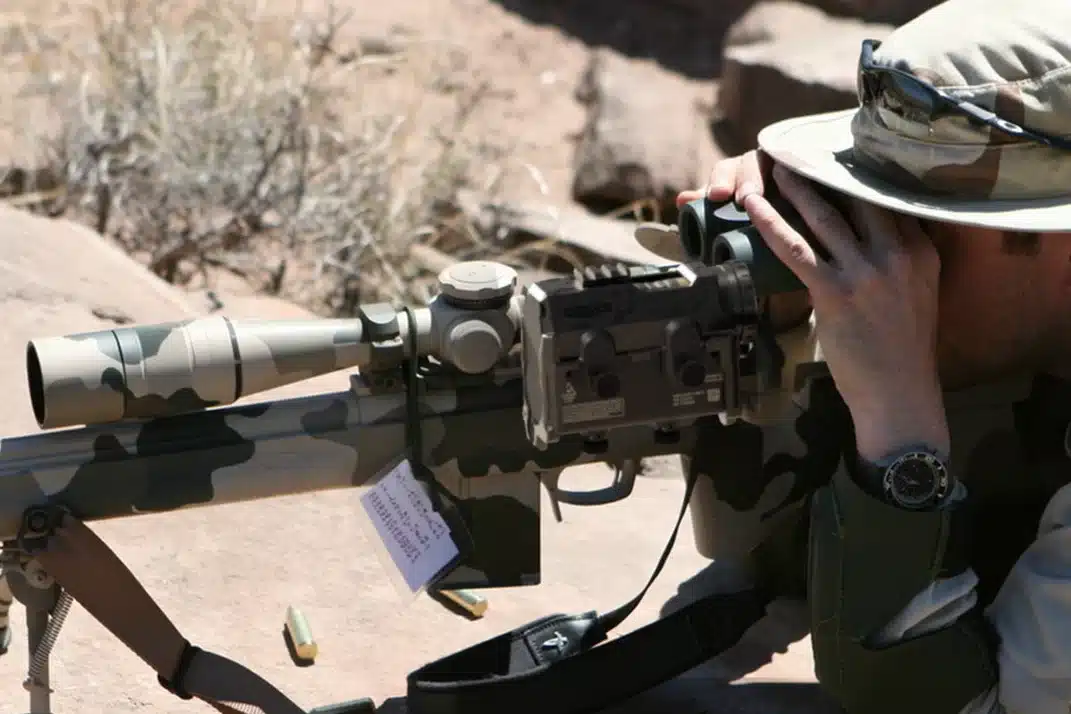
A handheld rangefinder in a Sightlok RF-1 mount has these advantages over a dedicated WMLRF:
- Superior ranging performance and functionality. Premium handheld rangefinders like the Sig Sauer KILO5K range farther, have a better ballistic engine, and connect to Kestrel wind meters for real-time windage calculations.
- Quick Detach to range objects you don’t want to point your muzzle at
- Keep rangefinder warm in your pocket until needed to avoid cold weather failures
- A lower price. If you already own a rangefinder, a Sightlok RF-1 setup costs $360, which is $1,140 less than a $1,500 dedicated WMLRF like the Vortex Impact 4000 or Tango Fire 4000.
- More flexible mounting options
- No rangefinder display shining on your face, which can reveal your position at night
- Fully integrated electro-optic systems such as the Sig Sauer BDX rangefinder and scope system, which calculates the firing solution and shows a holdover point in the scope reticle, so you don’t need to dial the scope’s elevation turret
A Sightlok RF-1 setup has one drawback: it typically has no remote. You press the range button with your support hand, which works fine off a bipod or bag, but you break your hold when you shoot standing, kneeling or braced.
Concerned about recoil damaging your rangefinder?
Handheld rangefinders are designed to survive drops of about 3 feet, and the impact from a 3-foot drop can generate several thousand psi of pressure. The RF-1 spreads recoil so evenly that no spot on your rangefinder takes more pressure than your thumb puts on the range button, a few dozen psi at most. A few dozen psi is well under 1% of the pressure your rangefinder is built to survive in a 3-foot drop. At that margin, the chance of a .308 shot damaging a healthy rangefinder in the RF-1 is effectively zero. In two years of selling the Sightlok RF-1, no customer has reported a rangefinder damaged by recoil. Read our full analysis of the recoil question and watch recoil test videos.
Here’s a documented test of the Sightlok RF-1 with the Sig Sauer KILO1000BDX rangefinder versus .308 rifle recoil:
Here’s a test of the Sightlok RF-1 with the Sig Sauer KILO1000BDX rangefinder versus 6.5 Creedmoor rifle recoil:
A low-budget option: the Laserworks LE-032
If you don’t need a ballistic calculator, the Laserworks LE-032 is a low-budget WMLRF that works with the Sightlok RF-1. The Laserworks LE-032 costs about $160, compared with $1,500 for a dedicated WMLRF. The mount that comes with the Laserworks LE-032 is floppy and unusable, but the rangefinder itself is functional enough when you mount it in a Sightlok RF-1, which holds it steady. The setup looks like this:

Learn more about the Sightlok RF-1 for the Laserworks LE-032.
Or watch an independent, uncompensated review of the Sightlok RF-1 by the famous long-range shooter MarkandSam AfterWork here.
Disagree with our comments? We want your opinion! Voice it below.
Ready to Build a Better WMLRF?
Keep the rangefinder you already own, mount it on your rifle, and co-witness it to your scope.
 Try the
New here?
Mount your rangefinder to your weapon
The Sightlok RF-1 is a Picatinny / Weaver rail mount that turns the handheld rangefinder you already own into a weapon-mounted laser rangefinder.