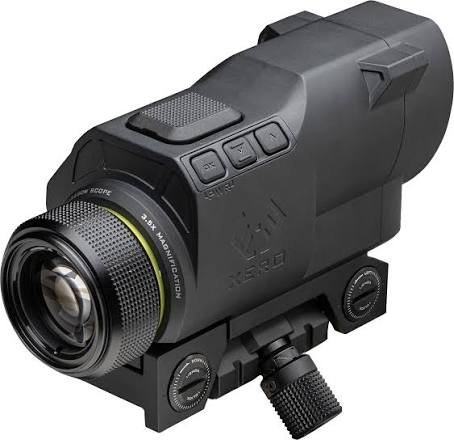
Q: Should I buy a Garmin Xero X1i?
A: Short answer: Absolutely not, especially if you want to fill your freezer when hunting season rolls around. This review explains why we’re not fans of the Garmin Xero X1i, and lists a far better alternative for you to consider.
Q: What problems does the Garmin Xero X1i have?
A: The top 5 most critical issues of the Garmin Xero X1i are:
Far too much magnification for crossbow range — instead of hunting the animal, you end up hunting around for it inside the scope. More info here.
An extremely narrow field-of-view — a deer barely fits inside it at normal crossbow distance, and a moving animal leaves it entirely. More info here.
A flagship price for an optic that’s wrong for the weapon — the build we recommend costs less and outperforms it on every count. More info here.
A rangefinder that can’t be removed — leaving you no way to comply where state rules restrict rangefinding optics on a hunting weapon. More info here.
It mounts too high and won’t take standard scope rings — hurting your cheek weld and your consistency, with no choice of mounting hardware. More info here.
Q: What’s the best alternative to the Garmin Xero X1i?
Q: What’s better than a Garmin Xero X1i?
A: No single product combines a rangefinder, a ballistic calculator and an illuminated holdover dot at 1X the way the Garmin does at 3.5X — so you build it, and it comes out cheaper. A Sig Sauer EASY6-BDX 1-6X LPVO at about $1,000, a Sig Sauer KILO2200 BDX rangefinder at $130, and a Sightlok RF-1 mount at about $250 to co-witness the two — roughly $1,380 all in, against $1,400 for the Garmin. Already own a Sig BDX rangefinder? You’re at about $1,250. You get every feature the Garmin advertises, a field-of-view four times wider, and a scope that actually works at the 22 yards where crossbow hunters take their shots. Here’s what the finished setup looks like:

For more information about the Sightlok RF-1 and how it co-witnesses a handheld rangefinder with your scope, click here.
Q: What about the Garmin Xero X1i vs the TenPoint EVO-X or Burris Oracle X?
A: All three suffer from the same core mistake, but the Garmin Xero X1i is the worst offender. The TenPoint EVO-X starts at 2X and the Burris Oracle X at 2X, which also suffers from having half the field-of-view you want for a successful hunt. The Garmin’s fixed 3.5X gives you an even narrower field-of-view than either of them.
👉 Read below for the full breakdown, including the field-of-view numbers and answers to the questions buyers ask most.
Or jump straight to an answer: Is it worth it? · What magnification do I actually need? · How narrow is the field-of-view? · Is it legal in my state? · What should I buy instead? · See all FAQs
1. The Garmin Xero X1i’s Fixed 3.5X Magnification Is Wrong for Crossbow Range
If you’ve been following our blog, you probably already know we’re outspoken critics of excessive scope magnification. There’s a common misconception among hunters, shooters, and even scope manufacturers that more magnification is better. People think that more magnification allows them to “see better,” when in fact more magnification usually results in “seeing less” and “seeing worse.” The Garmin Xero X1i is a classic case of an over-magnified optic that results in seeing less and seeing worse.
The Average Crossbow Hunting Distance Is 22 Yards
A 2014-15 survey of 3,044 hunters found the average crossbow shot that HIT the target was just 22.4 yards, while the average MISSED shot was 32 yards. Even with today’s faster crossbows, the vast majority of successful crossbow hunts still take place at less than 50 yards. That means a crossbow scope absolutely needs to start at 1X power.
Even a 2X Minimum Is an Impediment
At 15-35 yards, the field-of-view at 2X is already too narrow. Instead of hunting wild game, you’re hunting around trying to ACQUIRE THE TARGET in your scope.
Garmin Chose 3.5X, Fixed
They gave the Garmin Xero X1i a magnification level suited to shooting hundreds of yards out, when crossbow hunters are shooting a small fraction of that distance. Shame on Garmin for doing this.
2. The Garmin Xero X1i’s Field-of-View Is Just 6.5 Feet at 25 Yards
Here’s what that 3.5X magnification costs you in practice:
| Distance | Garmin Xero X1i field-of-view |
|---|---|
| 100 yards | 26 feet |
| 50 yards | 13 feet |
| 25 yards | 6.5 feet |
Six and a half feet of field-of-view at the distance where most crossbow hunters actually shoot. A deer at 25 yards barely fits inside it, and a moving animal leaves it entirely. By comparison, a Sig Sauer EASY6-BDX at 1X gives you 106 feet at 100 yards — nearly four times the Garmin’s.
This is just sad. The trend means less food in hunters’ freezers, and many hunters don’t know enough about optics to realize it.
Want Rangefinding, Ballistics, and a Smart Aim Point — at 1X?
The Garmin packs all three into one unit, but its fixed 3.5X makes it unusable at crossbow range. No single product combines these features at 1X — you have to build it: a Sig Sauer EASY6-BDX 1-6x24mm LPVO, a Sig Sauer BDX rangefinder, and a Sightlok RF-1 mount to co-witness them.
3. The Garmin Xero X1i Costs $1,400 — More Than a Better Setup
Fourteen hundred dollars for a scope with a tenth of the usable field-of-view a crossbow hunter needs. And the build we recommend isn’t a budget compromise you settle for — it’s both cheaper and considerably better:
| Component | Cost |
|---|---|
| Sig Sauer EASY6-BDX 1-6X scope | about $1,000 |
| Sightlok RF-1 mount | about $250, depending on how you mount it |
| Sig Sauer KILO2200 BDX rangefinder | $130 |
| Total | about $1,380 |
| Garmin Xero X1i | $1,400 |
So you come in under the Garmin’s price, and that’s before the obvious saving: if you already own a Sig BDX rangefinder — and plenty of hunters do — drop the last line and you’re at roughly $1,250, more than $100 cheaper again.
For that money you get four times the field-of-view, true 1X so you can shoot with both eyes open, a removable rangefinder you can take off for state law compliance, better glass, longer battery life, and more elevation and windage adjustment. The cheaper option is also the better one.
And there’s a cost that never shows up on any invoice. You sat in that stand since before first light. The deer steps out at twenty-five yards, and instead of putting the crosshair on it you’re sweeping a six-and-a-half-foot field-of-view around the woods trying to find the animal you can plainly see with your naked eye. By the time you get it into your sights, it’s gone. You drive home with an empty cooler and a $1,400 scope on your crossbow.
How do you put a price on that? Whatever number you land on, it dwarfs the difference between $1,380 and $1,400.
4. The Garmin Xero X1i’s Rangefinder Can’t Be Removed
The rangefinder is built into the unit permanently. That’s a legal problem, not just an inconvenience — a number of states restrict or prohibit rangefinding optics mounted on a hunting weapon, and with the Garmin you have no way to comply short of taking the whole scope off. A separate rangefinder in a Sightlok RF-1 mount comes off with a lever.
5. The Garmin Xero X1i Mounts Too High and Won’t Take Standard Rings
The Garmin sits higher above the rail than it needs to, which hurts your cheek weld and your consistency. It also doesn’t work with standard scope rings, so your mounting options are whatever Garmin decided you get. The Sig Sauer sits lower and takes ordinary rings.
What to Buy Instead of the Garmin Xero X1i
No single product on the market combines a rangefinder, ballistic calculator, and illuminated holdover dot at 1X magnification the way the Garmin does at 3.5X. To get all three at a usable magnification for crossbow range, you build the combination yourself — starting with the Sig Sauer EASY6-BDX LPVO 1-6X, at about $1,000.
The EASY6-BDX has a wide field-of-view — 106 feet at 100 yards, nearly four times the Garmin’s. Add a Sig BDX rangefinder and a Sightlok RF-1 mount, which co-witnesses the rangefinder with the scope, and you have the full rangefinding, ballistics-calculating setup.
Your Shopping List
– Sig Sauer EASY6-BDX 1-6X scope — about $1,000
– Sightlok RF-1 rangefinder mount — about $250, depending on how you choose to mount it
– Sig Sauer KILO2200 BDX rangefinder — $130
That’s about $1,380 for the complete setup, against $1,400 for the Garmin Xero X1i. If you already own a Sig BDX rangefinder, skip the third line and you’re at roughly $1,250 — over $100 cheaper still.
Advantages of the Sig Sauer Build Over the Garmin Xero X1i
- 4X the field-of-view (106 feet vs 26 feet)
- At 1X it can be used both eyes open, like a red dot
- Much longer battery life, better glass, more durable
- Sits lower, and works with standard scope rings
- More elevation and windage adjustment, better reticle
- Applied Ballistics, and higher resolution internal LED hold points
- Better rangefinder, more rangefinder options, and it’s removable for state law compliance
Get the Garmin’s Features Without the Garmin’s Magnification Problem
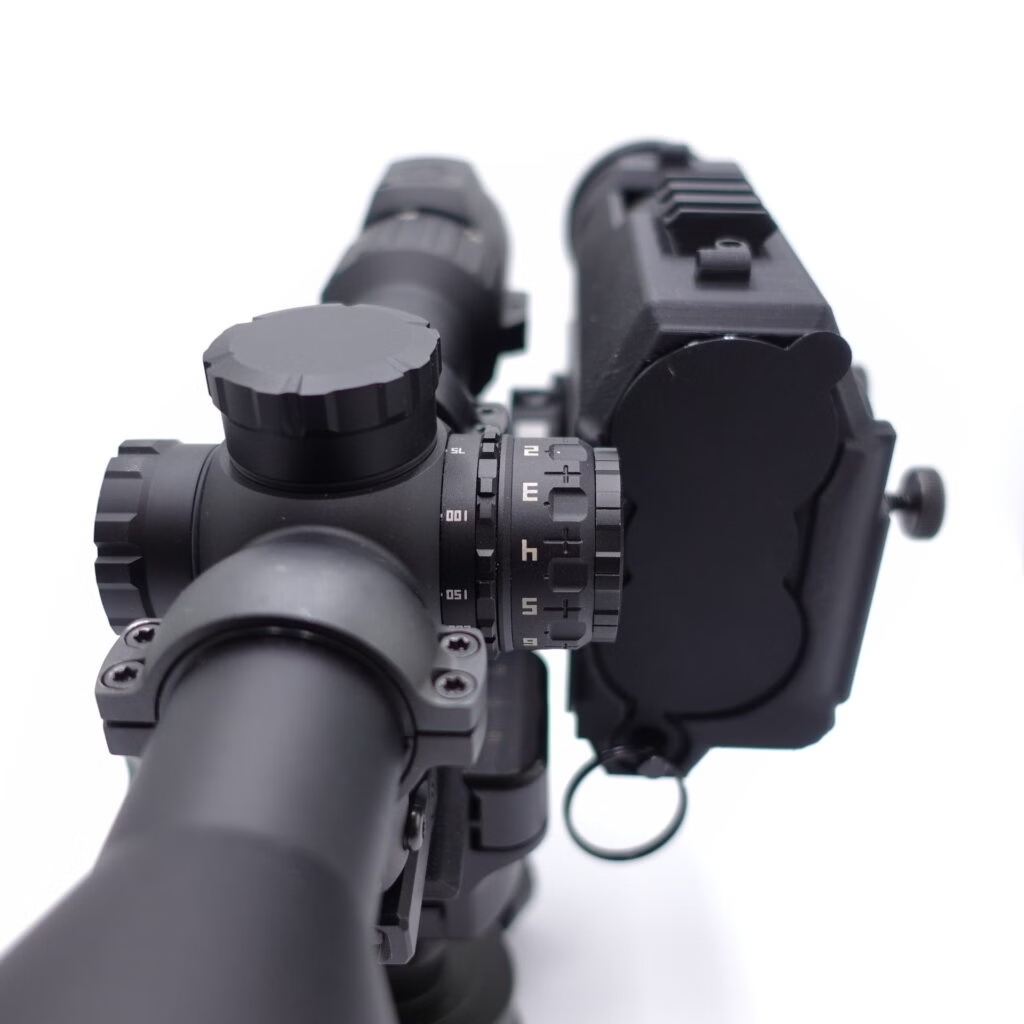
- Rangefinding + ballistic calculator + illuminated aim point — the same features the Garmin promises
- True 1X magnification, unlike the Garmin’s fixed 3.5X
- 4X wider field-of-view than the Garmin Xero X1i
- Removable rangefinder for state hunting law compliance
- Works with standard scope rings
Q: Is the Garmin Xero X1i worth it?
Q: Is the Garmin Xero X1i any good?
A: At $1,400, no. The technology is genuinely clever — rangefinder, ballistic solver and illuminated aim point all in one — but it’s built around a fixed 3.5X magnification that’s wrong for the weapon it’s mounted on. A crossbow hunter shooting at 22 yards needs the widest field-of-view he can get, and the Garmin gives him one of the narrowest on the market. Every other complaint on this page is secondary to that one.
Q: What magnification do I actually need on a crossbow scope?
A: 1X. The average crossbow shot that connects is 22.4 yards, and at that distance what you need is the widest field-of-view you can get, not a magnified one. Even a 2X minimum, which is what TenPoint and Burris ship, is already more than the job calls for. A scope that starts at 1X lets you shoot with both eyes open, like a red dot.
Q: How narrow is the Garmin Xero X1i’s field-of-view?
A: 26 feet at 100 yards, 13 feet at 50 yards, and 6.5 feet at 25 yards. That last number is the one that matters, because that’s roughly where crossbow hunters shoot. A Sig Sauer EASY6-BDX at 1X gives you 106 feet at 100 yards instead — close to four times as much.
Q: Is the Garmin Xero X1i legal to hunt with in my state?
A: Check your own state’s regulations before buying, because several restrict rangefinding optics mounted on a hunting weapon. The specific problem with the Garmin is that its rangefinder is permanently integrated — there’s no way to take it off and stay legal. A separate rangefinder on a quick-detach mount comes off in a second, which is why we prefer that arrangement.
Q: What should I buy instead of the Garmin Xero X1i?
A: A Sig Sauer EASY6-BDX 1-6X scope (about $1,000), a Sightlok RF-1 mount (about $250) to co-witness it, and a Sig Sauer KILO2200 BDX rangefinder ($130). That’s roughly $1,380 — less than the $1,400 Garmin, and about $1,250 if you already own a Sig BDX rangefinder. You get rangefinding, ballistic calculation and an illuminated holdover dot — the same three things the Garmin sells you — at a magnification that works at crossbow distance, with four times the field-of-view.
Q: Why do I need a Sightlok RF-1 if I already have a scope and a rangefinder?
A: Because a handheld rangefinder in your pocket doesn’t help you at the moment of the shot. The Sightlok RF-1 mounts it to the weapon and co-witnesses it with your scope, so you range exactly where you’re aiming — and you can still pull it off the rail to range by hand, or to comply with state law.
Q: Are the TenPoint EVO-X and Burris Oracle X any better than the Garmin Xero X1i?
A: Marginally, and for the same reason the Garmin fails: magnification. The TenPoint EVO-X is 2-8X and the Burris Oracle X is 2-7X, so both can at least be dialed down — but 2X is still more than a 22-yard shot calls for, giving you roughly half the field-of-view you should have. The whole category has gone in the wrong direction.
Who is Sightlok?
Sightlok publishes 100% factual, unbiased reports and reviews on electro-optics gear, with a particular focus on weapon-mounted laser rangefinders (WMLRF). Sightlok is the world’s leading independent expert on the various WMLRF options currently available. Sightlok is also the engineering and manufacturing team behind the highly-regarded Sightlok RF-1. If we can help someone find a product which perfectly meets their needs, or avoid a product which is less-than-ideal, our efforts were not in vain.
Where is this information sourced from?
The information is sourced from our own experiences with products in the field, and from customers we communicate with in the course of doing business, and from respected members posting on forums like Snipershide, Rokslide, and LongRangeHunting.
Did we miss anything in this report?
Disagree with anything we had to say?
Your opinion is precious, we would love to hear your feedback.
Any comments you leave below are published instantly, there’s no need to register before posting or verify your email address.
Ready to Build a Better Crossbow Optic?
Rangefinding, ballistics and a smart aim point — at a magnification that actually works at 22 yards.