Q: Tango Fire 4000 or Vortex Impact 4000 — which is the better WMLRF?
A: Of the two dedicated units, the Tango Fire 4000. It uses a wired remote, which avoids the battery drain and re-pairing delays that hold the Vortex Impact 4000 back in the field. The Vortex is the better-supported product of the two — onboard environmental sensors, a real warranty, a company that answers the phone — but it’s let down by its beam and its cold-weather record.
Q: What did you judge them on?
A: Eight criteria, in roughly the order they decide whether you get a usable range: beam quality, real-world ranging distance, how you trigger a range, ballistic software, whether you can range without pointing your muzzle at the target, cold-weather reliability, company support and warranty, and total cost. Each unit is scored against all eight below, with its pros and cons laid out.
Q: Is there a third option?
A: Yes, and most buyers don’t know about it. You can mount the handheld rangefinder you probably already own directly to your rifle, co-witnessed with your scope. It’s covered further down, after the two dedicated units.
👉 Read on for the full head-to-head, the pros and cons of each unit, and the option most people overlook.
Or jump straight to an answer: What is the best WMLRF? · Vortex or Tango? · Which has the best beam? · What’s the cheapest way to get one? · Do I need a dedicated WMLRF? · See all FAQs
How We Compared Them
A weapon-mounted laser rangefinder has one job: give you a trustworthy number, fast, from behind the rifle. Everything else is in service of that. So we judged all three options on the same eight criteria:
| Criterion | Tango Fire 4000 | Vortex Impact 4000 | Handheld + Sightlok RF-1 |
|---|---|---|---|
| Beam quality | Wide angled beam | Wide angled beam | Assuming a decent rangefinder like a Sig, narrow, round or rectangular with low beam divergence |
| Real-world range | 1,500 yds trees / 1,200 yds animals | Struggles past 400 yds in brush | 1,600 yds trees / 1,300 yds animals (assuming $130 Sig KILO2200) |
| Triggering a range | Wired remote — instant | Bluetooth remote — drain or delay | Button on the unit — 1-3 sec reach |
| Ballistic software | Applied Ballistics, cloud-only app | GeoBallistics (proprietary) | Applied Ballistics on Sig and other leading LRFs |
| Range without pointing muzzle at target | No — integrated unit | No — integrated unit | Yes — snaps off the rail |
| Cold weather | No major reports | Battery and display failures | Pocket it between shots |
| Support and warranty | Poor, documented complaints | Strong | Handheld maker’s warranty + Sightlok US-based |
| Cost | $1,500 | $1,500 | $380 |
What a Bad Beam Actually Looks Like
Beam quality sits at the top of that list because it decides more field failures than anything else — and it’s the one thing a buyer never gets to see before handing over the money. So here is the Vortex Impact 4000’s ranging laser, photographed through night vision:

That canted, slash-shaped smear is the whole problem in one picture. Very little of the energy is concentrated on the point you’re actually aiming at, and the rest of it is spread across whatever else happens to be nearby — branches, grass, the ground in front of your target. The unit can’t tell you which of those it just measured.
Tango Innovations doesn’t publish a beam divergence figure for the Fire 4000 at all. But the field reports describe the same behaviour, in the same conditions, with the same symptoms. We actually suspect the two units use the same ranging laser.
Here’s how those beams compare to three handheld rangefinders, from the cheapest Sig to the flagship:
| Rangefinder | Beam divergence | Beam pattern |
|---|---|---|
| Vortex Impact 4000 | 2.0 x 0.2 MRAD | “Slash-shaped,” canted 45° |
| Tango Fire 4000 | Not published | Field reports describe a wide, angled beam |
| Sig KILO2200 | 1.4 MRAD | Round |
| Sig KILO5K | 1.3 MRAD | Round |
| Sig KILO8K-ABS | 1.2 x 0.25 MRAD | Rectangular, wider than tall |
Even the $130 KILO2200 — the cheapest rangefinder on that list — puts less spread on target than the Vortex does, and it does it in a round pattern rather than a canted slash. That’s the whole case for mounting a handheld in one line.
Tango Fire 4000
The Tango Fire 4000 gets the most important thing right, and then gives a lot of it back.
Pros
- Wired “rat’s tail” remote — instant ranging with no pairing, no standing battery drain, no flashing beacon
- True all-in-one package, nothing to assemble or align
- Runs Applied Ballistics rather than a proprietary solver
- No widespread cold-weather failure reports
Cons
- No built-in environmental sensors, which ballistic solutions depend on
- Outranged by a $130 handheld rangefinder
- Same wide, angled beam problem as the Vortex
- Two unfixed firmware bugs affecting your firing solution
- Ballistic app moving to cloud-only — no offline drag curves
- Poor documented customer support
The wired remote is a genuine win. It’s the single biggest practical advantage the Tango holds over the Vortex: press the button by your trigger hand and you have a range, every time, with nothing to wake up or reconnect.
But the sensors are missing. The Fire 4000 has no built-in environmental sensors, and on its own website the company repeatedly implies it isn’t sure why its engineers left them out — which raises real questions about whether the product was designed in China despite “Designed in U.S.” labeling.
And it’s outranged by a $130 handheld. In real-world ranging a $130 Sig Sauer KILO2200 beats the $1,500 Tango: 1,600 yards vs. 1,500 yards on trees, 1,300 vs. 1,200 on animals.
The firmware bugs are the serious part. Engage continuous ranging and after 2-3 ranges the unit keeps ranging but silently stops updating your dope, with no warning at all. Separately, with the phone app connected, slope calculations use the angle of your phone rather than your rifle. Neither has been fixed or acknowledged.
Read our full Tango Fire4000 review here.
Vortex Impact 4000
The Vortex is the more complete product on paper, and the better company behind it. Its problems are in the hardware.
Pros
- Onboard environmental sensors — compass, temperature, pressure, humidity
- Vortex’s VIP warranty and a support operation that actually answers
- Genuinely well-built, and a true all-in-one package
- Patented Wind Bearing Capture mode
Cons
- Wide 45° slash-shaped beam that catches brush, grass and terrain
- Bluetooth remote — drains batteries connected, slow to re-pair if not
- Battery and display failures in cold weather
- GeoBallistics instead of the industry-standard Applied Ballistics
- Compass calibration many owners can’t complete
- Night display that can’t be dimmed
- Needs about $500 of special scope rings on top
Give Vortex credit where it’s due. The Impact 4000 has the onboard sensor suite the Tango lacks, it’s backed by a real warranty, and if something goes wrong you can get a human on the phone. That’s worth something, and it’s why the Vortex isn’t simply the worse product.
The beam is the problem. Vortex’s own published figures put it at 2.0 x 0.2 MRAD canted 45° — ten times wider on one axis than the other. A side-by-side test against a Leica found the Vortex couldn’t read through gaps in trees the Leica handled cleanly, and owners report inconsistent readings through grass and brush inside 150 yards.
The Bluetooth remote is why it ranks below the Tango. Leave it paired and you drain batteries in both units; power down and every range starts with a re-pair. The Tango’s wire solves this outright.
Cold weather is a documented weak point. Multiple Sniper’s Hide threads report battery life dropping to as little as 15 minutes, and at the Mammoth Sniper Challenge nearly all of roughly 30 Impact 4000 shooters had failures or major ranging problems.
Read our full Vortex Impact 4000 review here.
The Third Option Most Buyers Don’t Consider
Here’s the thing almost nobody weighing these two units stops to think about: the laser in a good handheld rangefinder is better than the laser in most dedicated WMLRF, including both the Vortex and the Tango.
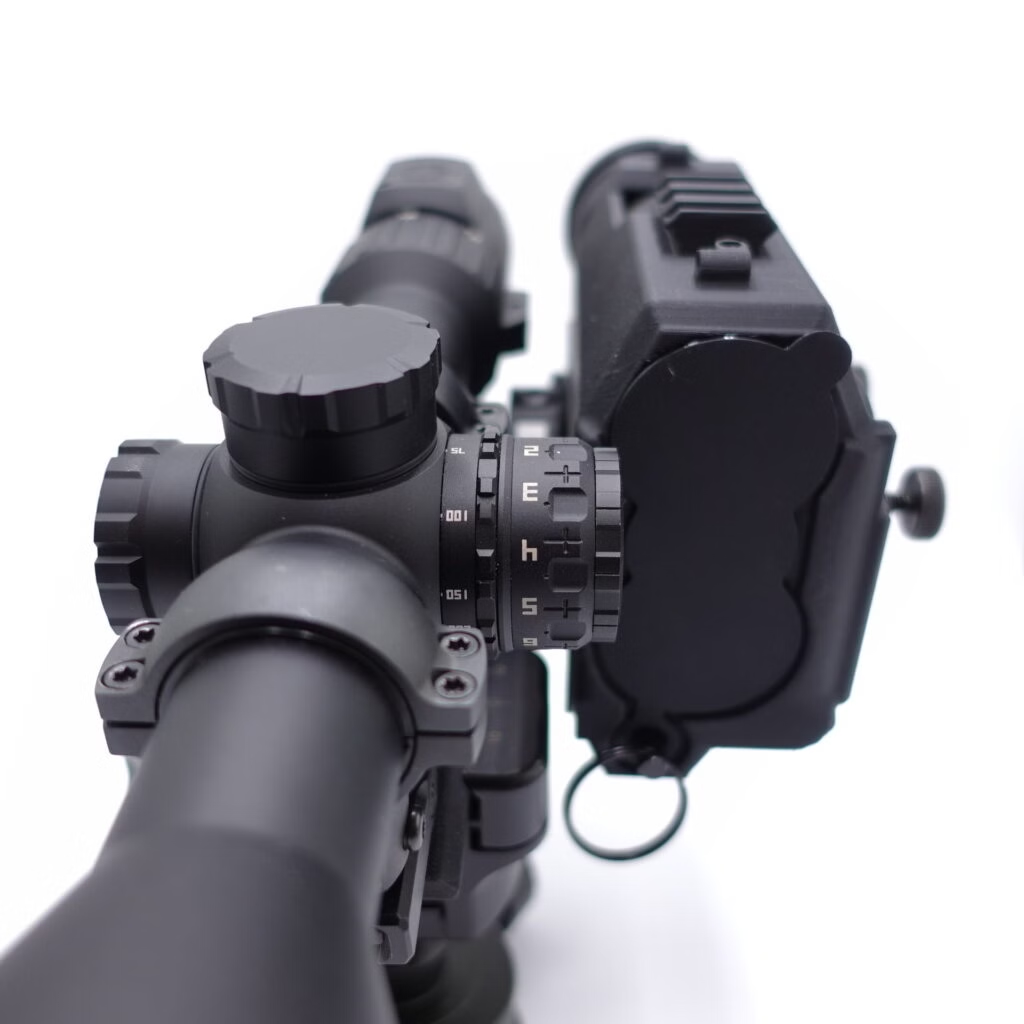
Dedicated WMLRFs have their place — the military uses them, and for good reasons. But for most shooters the assumptions that made them the only option no longer hold. A handheld couldn’t be mounted to a rifle at one time, and many people assumed recoil would kill a handheld anyway, which we’ve also discovered is an outdated notion. A quick-detach mount puts your handheld on the rail, co-witnessed with your scope, so it ranges exactly where you’re aiming — and comes off in a second when you want to range by hand.
That’s what the Sightlok RF-1 does. Insert the rangefinder you already own, clamp it to the weapon, secure the protective cover, co-witness it to your scope.
Pros
- Assuming you’re using a decent handheld like a Sig KILO2200 or better, narrower, cleaner beam than either dedicated unit — reads through brush instead of catching it
- Snaps off the rail in a second so you can range a target without pointing your muzzle at it — scout, confirm a distance, or range near people and livestock, then snap it back on co-witnessed. No dedicated WMLRF can do this
- Longer real-world ranging distance, even with an entry-level handheld
- Works with almost any handheld rangefinder — you’re not locked to one brand
- Applied Ballistics on Sig and other leading LRFs, with onboard environmental sensors on Sig’s handhelds from the KILO3K up
- Keep it warm in your pocket between shots in the cold
- No bright display on the rifle giving away your position at night
- $380 all in, against $1,500 for either dedicated unit
- Your handheld’s own warranty plus US-based Sightlok support
Cons
- No remote. You reach up and press the range button on the rangefinder itself, which costs you an extra 1-3 seconds — better than waiting on a Bluetooth remote, but not as quick as the Tango’s wired button by your trigger hand
That remote point is a real trade-off and worth being straight about. If your priority is the absolute fastest possible range with your hand never leaving the grip, the Tango’s wired remote beats reaching up to the unit. On every other criterion we listed — beam, range, software, ranging without pointing your muzzle at the target, cold weather, night use, support, and cost — the mounted handheld comes out ahead.
Want to See How It Mounts?
The Sightlok RF-1 co-witnesses a handheld rangefinder with your scope, and comes off the rail with a lever.
The Verdict
1st Place
A handheld rangefinder in a Sightlok RF-1. Pair it with a decent handheld like a Sig and you get a better beam and longer range than either dedicated unit — and it’s the only option here that lets you range a target without pointing your muzzle at it. Add better ballistic software, usability in cold and at night, and about a quarter of the price. Its one drawback is the missing remote.
2nd Place
Tango Fire 4000. The wired remote is the best triggering solution of the three, and that counts for a lot. But no environmental sensors, a wide beam, two unfixed firmware bugs and poor support keep it out of first.
3rd Place
Vortex Impact 4000. The best-supported product here, with the sensors the Tango lacks — but the beam, the Bluetooth remote and the cold-weather record put it last for field use.
Build the Best WMLRF on the Market
Assuming you’re using a cheapo $130 Sig Sauer KILO2200:
- Longer ranging distance than either dedicated WMLRF, at a fraction of the price
- A narrower, cleaner beam that reads through brush instead of catching it
- No firmware bugs, no cloud-only software, no Bluetooth remote headaches
- Range by hand without pointing your muzzle at what you’re ranging
- Backed by real warranties and real customer support
Q: Vortex Impact 4000 or Tango Fire 4000 — which is better?
A: The Tango Fire 4000, mainly because of its wired remote: no pairing delay, no standing battery drain, no flashing beacon. The Vortex is the better-supported product and it has the onboard environmental sensors the Tango lacks, but its wide angled beam and its cold-weather failures cost it more in the field than the sensors gain it.
Q: What is the best WMLRF?
Q: What is the best weapon-mounted laser rangefinder?
A: A quality handheld rangefinder mounted in a Sightlok RF-1 — almost any decent handheld works, you’re not tied to one brand. It has a cleaner beam, longer real-world range and better ballistic software than either dedicated unit, it comes off the rail when you want it to, and it costs about a quarter as much. The one thing it gives up is a trigger-hand remote. Among the dedicated units, the Tango Fire 4000 beats the Vortex Impact 4000.
Q: Which WMLRF has the best beam divergence and beam pattern?
A: The handhelds, by a clear margin. The Vortex Impact 4000 has both the widest beam of the group and the only irregular pattern — an elongated slash canted at 45° — and Tango Innovations doesn’t publish a figure for the Fire 4000. Even the cheapest Sig handheld puts less spread on target than the Vortex does. See the full beam divergence comparison table here, along with a night-vision photo of the Vortex’s beam.
Q: Can you range a target without pointing your rifle at it?
A: Only with a mounted handheld, and it’s one of the biggest practical advantages here. Both the Vortex Impact 4000 and the Tango Fire 4000 are single integrated units, so whatever you range, your muzzle is pointed at — no scouting a target, no confirming a distance on something you’re not ready to shoot, and no way to avoid pointing your muzzle at other people or livestock. With the Sightlok RF-1 you flip a lever, pull the rangefinder off the rail, range by hand, and snap it back on without losing your co-witness. No dedicated WMLRF can do this.
Q: Which one is fastest to range with?
A: The Tango Fire 4000. Its wired remote sits by your trigger hand, so a range costs you a button press and nothing else. A handheld in a Sightlok RF-1 has no remote — you reach up and press the button on the rangefinder, which adds one to three seconds. That’s still quicker than the Vortex Impact 4000, where a Bluetooth remote either has to be kept awake or woken up and re-paired.
Q: What’s the cheapest way to get a weapon-mounted laser rangefinder?
A: Mount a handheld rangefinder you already own — that’s just the cost of the mount, $250. Starting from nothing, a $130 Sig Sauer KILO2200 plus a Sightlok RF-1 comes to $380, against $1,500 for either dedicated unit. And the cheap combination still outranges both.
Q: Do I need a dedicated WMLRF, or is a mounted handheld good enough?
A: A mounted handheld isn’t a compromise — on the measurements that decide whether you get a clean range, it’s the better instrument. Dedicated units have their place, and the military uses them, but for most shooters the handheld route wins on beam quality, range, software and cost. The one thing the dedicated units still do better is the trigger-hand remote.
Q: Which handheld rangefinder should I pair with the Sightlok RF-1?
A: Obviously this depends on how far you’re shooting. If you’re shooting ultra-long distance, you may need something like a Sig KILO8K-ABS or a Sig KILO5K. But really any handheld rangefinder should be perfectly sufficient for most shooters. It doesn’t have to be a Sig Sauer. And many run-of-the-mill handheld rangefinders out there actually outperform both dedicated WMLRFs in terms of beam range and quality. So evaluate your own shooting objectives and choose a rangefinder which meets those objectives. There’s no need for everyone out there to own a Sig KILO8K-ABS — that would be way overkill for most.
Q: What warranty do you get on each option?
A: Handheld rangefinders generally carry strong warranties — Sig Sauer’s Electro-Optics Infinite Guarantee, for instance, is a fully transferable lifetime warranty covering both structural and electronic components — and Sightlok backs its own mounts with American support and engineering staff. Vortex has a real support operation behind the Impact 4000. Tango Innovations has the weakest record of the three, with documented complaints about how customers are handled.
Who is Sightlok?
Sightlok publishes 100% factual, unbiased reports and reviews on electro-optics gear, with a particular focus on weapon-mounted laser rangefinders (WMLRF). Sightlok is the world’s leading independent expert on the various WMLRF options currently available. Sightlok is also the engineering and manufacturing team behind the highly-regarded Sightlok RF-1. If we can help someone find a product which perfectly meets their needs, or avoid a product which is less-than-ideal, our efforts were not in vain.
Where is this information sourced from?
The information is sourced from our own experiences with products in the field, and from customers we communicate with in the course of doing business, and from respected members posting on forums like Snipershide, Rokslide, and LongRangeHunting.
Did we miss anything in this report?
Disagree with anything we had to say?
Your opinion is precious, we would love to hear your feedback.
Any comments you leave below are published instantly, there’s no need to register before posting or verify your email address.
Ready to Build a Better WMLRF?
Keep the rangefinder you already own, mount it to your rifle, and co-witness it to your scope — for a fraction of what a dedicated WMLRF costs.