Q: Should I buy a Vortex Impact 4000?
A: Short answer: Probably not. That’s not to say that the Vortex Impact 4000 doesn’t have loyal customers who swear by it. But having said that, many of these same loyal customers have never tried the better alternatives out there, so they have nothing to compare it to. This review explains why we’re not huge fans of the Vortex Impact 4000, and lists alternatives for you to consider.
Q: What problems does the Vortex Impact 4000 have?
A: The top 6 most critical issues of the Vortex Impact 4000 are:
Excessive beam divergence and a diagonal beam pattern — catches brush, trees, and terrain alongside your target, causing inaccurate readings. More info here.
A Bluetooth remote rather than a wired one — leave it connected and it drains your batteries, power it down and you wait for it to re-pair before every range. More info here.
Poor cold weather battery performance — the unit runs down fast in winter conditions, and its ranges stop being trustworthy before it dies. More info here.
A display that degrades in the cold — it slows down and can stop working entirely, leaving you unable to read a range when you need one fast. More info here.
A compass calibration routine many owners can’t complete — and it has to be repeated every time you move to a new location. More info here.
A night display that can’t be dimmed — it lights up your rifle and your face, ruining your night vision and giving away your position. More info here.
Q: What’s the best alternative to the Vortex Impact 4000?
Q: What’s better than a Vortex Impact 4000?
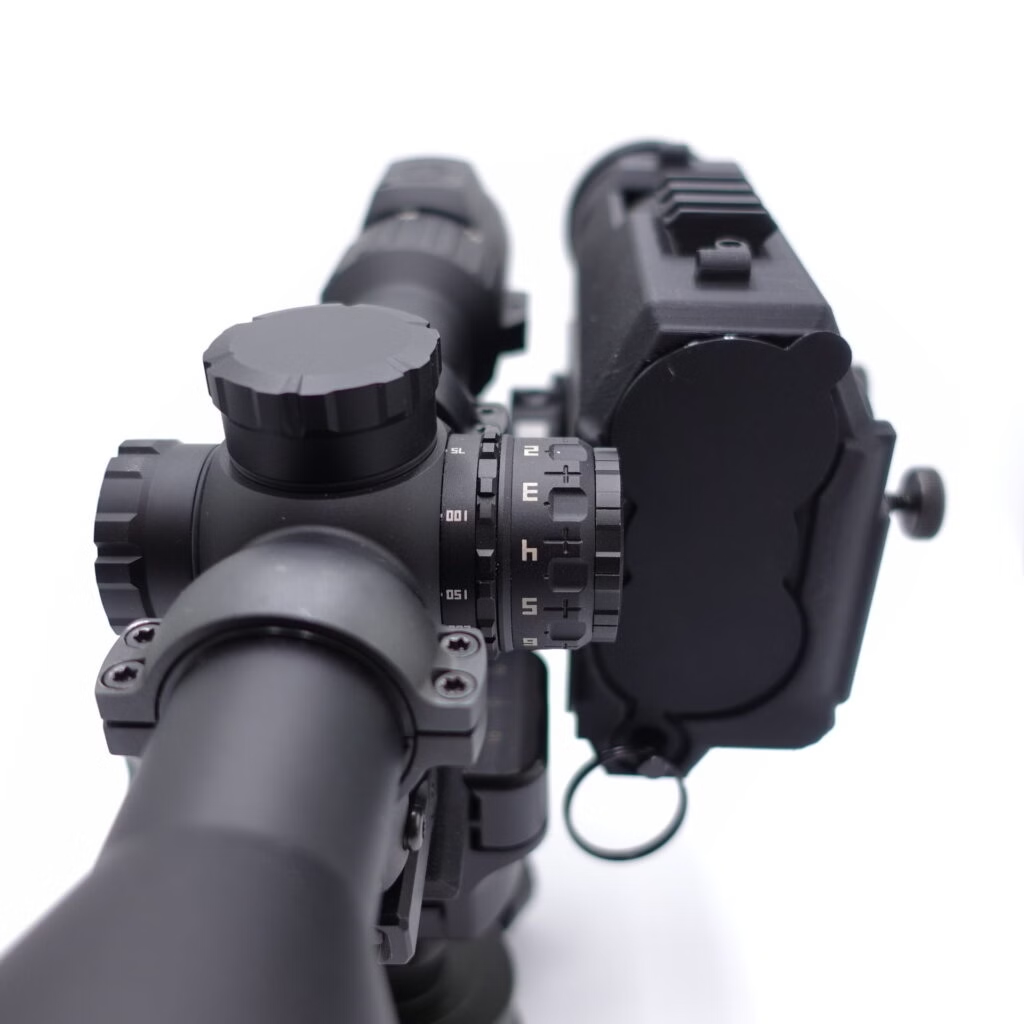
A: If you already own a high-quality handheld laser rangefinder, you have a core component that already likely outperforms the Vortex Impact 4000 — you just need a way to mount it to your weapon. And today that is possible with the Sightlok RF-1 rangefinder mount. You insert the rangefinder you already own into the mount, mount it to your weapon, secure the protective cover, co-witness the rangefinder to your scope, and you’ve just saved yourself $1,500 and gotten a better overall WMLRF solution. When you’re done, your setup will look something like this:

For more information about the Sightlok RF-1 and how it turns your handheld rangefinder into a weapon-mounted laser rangefinder (WMLRF) that can outperform the Vortex Impact 4000, click here.
Q: What about the Vortex Impact 4000 vs the Tango Fire4000?
A: We think the Tango Fire4000 is better overall because it uses a wired remote, so it avoids the battery drain and slow re-pairing that come with the Impact 4000’s Bluetooth remote. Click here to learn more about the Tango Fire4000.
👉 Read below for the full breakdown, including forum-sourced field reports and answers to the questions buyers ask most.
Or jump straight to an answer: Is it worth it? · How far does it really range? · Is it accurate? · Does it work in cold weather? · Can you dim the display at night? · See all FAQs
1. The Vortex Impact 4000’s Beam Shape Makes It Unreliable Around Brush and Clutter
The Impact 4000’s laser has a wide, oddly-shaped beam, and that’s the root cause behind a long list of accuracy complaints.
What are the Vortex Impact 4000’s Ranging Laser Specs?
Per figures Vortex gave directly to users on Sniper’s Hide, the Impact 4000’s beam divergence is 2.0 x 0.2 MRAD at a 45° angle — a “slash-shaped” beam, angled so the unit can be mounted top or side rail. On its wide axis, that’s ten times larger than on its narrow axis, and roughly 67% wider than the compact rectangular footprint of a comparable handheld rangefinder. Beam shape directly determines how much extraneous material — branches, grass, terrain — a laser pulse can catch alongside the actual target, and a wider, more lopsided beam is simply more likely to return a false or blended reading. (Side-by-side beam numbers are further down the page.)
Here’s an actual picture showing the unwieldy shape and rather extreme beam divergence of the Vortex Impact 4000:

What Vortex Impact 4000 Users Report
Forum users consistently tie the “slash-shaped” beam to the same failure mode: it isolates targets poorly, so it reads whatever’s nearby instead. A side-by-side test against a Leica found the Vortex couldn’t read through gaps in trees that the Leica handled cleanly, with the Leica landing within a yard of confirmed range. Others describe the beam picking up ground or nearby objects instead of the intended target, and one user simply couldn’t see how the diagonal beam shape was meant to work.
That plays out consistently in the field. Owners report inconsistent readings through grass and tree branches inside 150 yards while the same unit reads distant buildings cleanly, minor issues with grass or brush in front of the target, a 500-yard dial solution paired with a 50-yard distance readout plus occasional freezing, and trouble ranging past 400 yards in brushy terrain with few reflective targets — see here, here, here, and here.
If your shooting environment has any brush, grass, or clutter near the target — which describes most real-world hunting and field conditions — this beam problem alone is reason enough to look elsewhere.
2. The Vortex Impact 4000’s Bluetooth Remote Is a Liability in the Field
Never buy a WMLRF with a Bluetooth remote. You want a wired remote, or you want to be able to directly push the range button on the unit itself — like you can with a handheld rangefinder in a Sightlok RF-1 mount.
The trouble is Bluetooth itself: it forces a choice, and there’s no good option on either side of it. Either you leave the remote paired and connected times, and you’re bleeding the batteries in both the remote and the rangefinder just to hold the connection open — batteries that don’t last long in the field to begin with. Or you power down the unit between uses to save that battery, and now every single range check starts with waiting for it to boot up and re-pair — an impossibly slow process when you need a fast reading, whether you’re on a timed stage or watching an animal that won’t hold still while your rangefinder reconnects.
A wired remote or a direct push-button doesn’t have this problem — it’s instant, every time, with no pairing step and no standing battery drain.
3. Cold Weather Guts the Vortex Impact 4000’s Battery Life
Drop the temperature and the Impact 4000’s runtime falls off a cliff. In one of several Sniper’s Hide threads on the subject, an owner training in 15°F weather with light snow cover found the unit was good for roughly fifteen minutes of use — with the backlight off entirely. He also noticed the screen blanking for a moment each time the laser fired before the range appeared, and once the low-battery icon started flashing, the ranges it produced stopped being trustworthy.
That wasn’t an isolated unit, either. A member of the same thread reported that of the roughly thirty shooters running Impact 4000s at the Mammoth Sniper Challenge, almost every one of them dealt with either outright failure or serious ranging problems once the cold set in. For a rangefinder marketed at hunters and long-range competitors — people who are outdoors in winter by definition — that’s a hard limitation to design around.
4. The Vortex Impact 4000 Display Slows Down and Can Quit Entirely in the Cold
The same cold that drains the battery also degrades the screen itself. Owners report the display becoming sluggish as temperatures fall, with readouts lagging behind the ranging action, and in some cases the display stopping altogether. A rangefinder you can’t read is a rangefinder you don’t have, and this one is at its least reliable in exactly the conditions where a quick, confident number matters most.
5. Vortex Impact 4000 Calibration Defeats a Fair Number of Owners
The Impact 4000 requires a calibration routine, and it’s neither quick nor forgiving. Scroll the comments on this walkthrough video and you’ll find owner after owner who simply couldn’t get through the process. Worse, it isn’t a one-time chore: users report having to run it again whenever they move to a new location.
It’s worth pointing out that most competing rangefinders ask nothing of the sort. Calibration is a step the Impact 4000 adds to your day that a good handheld rangefinder on a Sightlok RF-1 mount simply doesn’t have.
6. The Vortex Impact 4000 Display Is Blindingly Bright at Night
Range a target after dark and the Impact 4000’s LCD floods your rifle and your face with light. That’s a problem on two fronts: it can give your position away to whatever you’re ranging, and it destroys the dark adaptation you spent the last half hour building. A lot of owners have run into this one.
The photo below gives some idea of how much light we’re talking about:

Because the backlight has exactly two settings — on and off — there’s no way to simply turn it down. That’s pushed owners into workarounds: sticking window tint film over the display to cut the output, or killing the backlight entirely and reading the screen with a small external light. Neither is something you should have to do on a $1,500 rangefinder.
7. The Vortex Impact 4000’s Ballistic Software Is a Step Down From the Industry Standard
The Impact 4000 runs Vortex’s own in-house solver, GeoBallistics — not Applied Ballistics, the third-party engine used across most of the higher-end long-range rangefinder market. GeoBallistics pulls from on-board compass, temperature, pressure, and humidity sensors, plus a patented Wind Bearing Capture Mode, and supports 10 preloaded, customizable ballistic profiles through a companion app.
That’s a genuinely different pedigree of software, not just a smaller feature set. Applied Ballistics has a long track record across many rangefinder, scope, and Kestrel products from multiple manufacturers — it’s the de facto standard competitors are measured against. GeoBallistics is proprietary to Vortex, built specifically for Vortex’s own product line, without that same cross-manufacturer track record. Choosing the Impact 4000 means trusting Vortex’s own solver on its own, with a smaller profile capacity (10, versus up to 25 across 8 groups on comparable Applied Ballistics units) and less of a proven reputation among long-range shooters.
Build a Better WMLRF Than the Impact 4000
Assuming you’re using a cheapo $130 Sig Sauer KILO2200:
- Narrower, cleaner beam than the Impact 4000 — reads through brush and clutter instead of returning false hits
- Applied Ballistics rather than Vortex’s proprietary GeoBallistics, on most quality handheld rangefinders
- No Bluetooth remote to fight with — range straight off the rangefinder’s own button or a wired remote
- Range targets by hand, without ever pointing your muzzle at them
- Use the rangefinder you already own instead of buying a $1,500 all-in-one unit
Q: Is the Vortex Impact 4000 worth it?
Q: Is the Vortex Impact 4000 any good?
A: At $1,500 we don’t think so. It’s a well-built all-in-one unit from a company with real support behind it, and for some shooters that’s enough. But you’re paying a premium for a wide, canted beam that struggles around clutter, a Bluetooth remote that either drains your batteries or makes you wait, cold-weather battery and display failures, a calibration routine many owners can’t finish, a night display that can’t be dimmed, and a proprietary ballistic solver instead of the industry-standard one. A quality handheld in a Sightlok RF-1 mount does the same job better, for a lot less.
Q: How far can the Vortex Impact 4000 actually range?
A: Far less than the name suggests once there’s anything near the target. Owners report clean results on distant buildings with nothing around them, but inconsistent readings through grass and tree branches inside 150 yards, and trouble ranging past 400 yards in brushy terrain with few reflective targets. Reflective-target figures are best-case laboratory conditions, not what you’ll see on game in cover.
Q: Is the Vortex Impact 4000 accurate?
A: Its accuracy depends heavily on what’s around your target. The 2.0 x 0.2 MRAD slash-shaped beam catches branches, grass and terrain alongside the target and returns a false or blended reading — one owner reported a 500-yard dial solution paired with a 50-yard distance readout. In the cold it gets worse: once the low-battery icon starts flashing, owners describe the ranges as unreliable.
Q: Does the Vortex Impact 4000 work in cold weather?
A: Poorly. At 15°F one owner got roughly fifteen minutes of runtime with the backlight off, and the display blanked each time the laser fired. The screen also slows down as temperatures fall and in some cases stops working altogether. At the Mammoth Sniper Challenge, nearly all of roughly thirty Impact 4000 shooters had either total failure or major ranging problems in the cold.
Q: What ballistic solver does the Vortex Impact 4000 use?
A: It runs Vortex’s own proprietary solver, GeoBallistics, rather than Applied Ballistics — the third-party engine used across rangefinders, scopes and Kestrel units from multiple manufacturers. You’re also limited to 10 ballistic profiles, versus up to 25 across 8 groups on comparable Applied Ballistics units.
Q: Does the Vortex Impact 4000 need to be calibrated?
A: Yes, and it’s neither quick nor forgiving. Plenty of owners report being unable to complete the process, and it isn’t a one-time chore — users report needing to run it again after moving to a new location. Most competing rangefinders ask nothing of the sort.
Q: Can you dim the Vortex Impact 4000 display for night shooting?
A: No. The backlight has two settings, on and off, with nothing in between. Ranging after dark floods your rifle and face with light, which can give away your position and destroys your dark adaptation. Owners have resorted to sticking window tint film over the display, or killing the backlight entirely and reading the screen with a small external light.
Q: What’s a key advantage of the Sightlok RF-1 over the Vortex Impact 4000?
A: With the Sightlok RF-1 you can range a target without pointing your rifle at it. The Vortex Impact 4000 is one integrated, weapon-mounted unit with no separable ranging function — to range anything, you point the rifle, and the laser riding on top of it, directly at whatever you want a number on. With the Sightlok RF-1 you can pull the rangefinder off the gun and range by hand whenever you want, then click it back onto the rifle, co-witnessed to your scope, and use it as a weapon-mounted rangefinder again.
Q: If I don’t already own a good handheld rangefinder, what would you recommend to use with the Sightlok RF-1?
A: Obviously this depends on how far you’re shooting. If you’re shooting ultra-long distance, you may need something like a Sig KILO8K-ABS or a Sig KILO5K. But really any handheld rangefinder should be perfectly sufficient for most shooters. It doesn’t have to be a Sig Sauer. And many run-of-the-mill handheld rangefinders out there actually outperform the Vortex Impact 4000 in terms of beam range and quality. For example, the laser in the $130 Sig Sauer KILO2200 outperforms the laser in the Vortex Impact 4000, and the software in the Sig is better as well. So evaluate your own shooting objectives and choose a rangefinder which meets those objectives. There’s no need for everyone out there to own a Sig KILO8K-ABS — that would be way overkill for most.
Q: What is the beam divergence and beam pattern of the Vortex Impact 4000 versus the Sig KILO2200, KILO5K, and KILO8K-ABS?
A: The Vortex Impact 4000 has both the widest beam of the four and the only irregular beam pattern — an elongated slash canted at 45°, rather than the round or rectangular footprint the Sig units use. Even the cheapest Sig here puts less spread on target than the Impact 4000 does:
| Rangefinder | Beam divergence | Beam pattern |
|---|---|---|
| Vortex Impact 4000 | 2.0 x 0.2 MRAD | “Slash-shaped,” canted 45° |
| Sig KILO2200 | 1.4 MRAD | Round |
| Sig KILO5K | 1.3 MRAD | Round |
| Sig KILO8K-ABS | 1.2 x 0.25 MRAD | Rectangular, wider than tall |
On its wide axis the Vortex Impact 4000’s beam is ten times larger than on its narrow axis, and roughly 67% wider than the KILO8K-ABS. The wider and more lopsided the beam, the more brush, grass and terrain it can catch alongside the actual target — which is exactly what owners report in the field.
If accuracy, a reliable remote, cold-weather dependability, ballistic software quality, the ability to range without pointing a weapon, and cost matter to you, a handheld rangefinder in a Sightlok RF-1 beats the Vortex Impact 4000 on every one of these counts.
Who is Sightlok?
Sightlok publishes 100% factual, unbiased reports and reviews on electro-optics gear, with a particular focus on weapon-mounted laser rangefinders (WMLRF). Sightlok is the world’s leading independent expert on the various WMLRF options currently available. Sightlok is also the engineering and manufacturing team behind the highly-regarded Sightlok RF-1. If we can help someone find a product which perfectly meets their needs, or avoid a product which is less-than-ideal, our efforts were not in vain.
Where is this information sourced from?
The information is sourced from our own experiences with products in the field, and from customers we communicate with in the course of doing business, and from respected members posting on forums like Snipershide, Rokslide, and LongRangeHunting.
Did we miss anything in this report?
Disagree with anything we had to say?
Your opinion is precious, we would love to hear your feedback.
Any comments you leave below are published instantly, there’s no need to register before posting or verify your email address.
Ready to Build a Better WMLRF?
Keep the rangefinder you already own, mount it to your rifle, and co-witness it to your scope — for a fraction of what the Vortex Impact 4000 costs.