

Q: Should I buy a Tango Fire4000?
A: Short answer: Probably not. That’s not to say that the Tango Fire4000 doesn’t have loyal customers who swear by it. But having said that, many of these same loyal customers have never tried the better alternatives out there, so they have nothing to compare it to. This review explains why we’re not huge fans of the Tango Fire4000, and lists alternatives for you to consider.
Q: What problems does the Tango Fire4000 have?
A: The top 6 most critical issues of the Tango Fire4000 are:
No built-in environmental sensors — the unit can’t read the conditions its own firing solution depends on, so you depend on your mobile phone or a Kestrel to get that data. More info here.
Outranged by a cheap handheld rangefinder — you’re paying flagship money for less real-world reach than an entry-level $130 handheld unit delivers. More info here.
Excessive beam divergence and a diagonal beam pattern — catches brush, trees, and terrain alongside your target, causing inaccurate readings. More info here.
A continuous ranging bug that silently stops updating your dope — the unit keeps handing you numbers while your firing solution quietly goes stale, with no warning. More info here.
An inclinometer bug that reads your phone’s angle instead of your rifle’s — which throws off every uphill and downhill shot, exactly where angle compensation matters most. More info here.
A manufacturer that doesn’t acknowledge or fix the bugs in their product — months after they were first reported publicly, leaving owners to discover them in the field. More info here.
Q: What’s the best alternative to the Tango Fire4000?
Q: What’s better than a Tango Fire4000?
A: If you already own a high-quality handheld laser rangefinder, you have a core component that already likely outperforms the Tango Fire4000 — you just need a way to mount it to your weapon. And today that is possible with the Sightlok RF-1 rangefinder mount. You insert the rangefinder you already own into the mount, mount it to your weapon, secure the protective cover, co-witness the rangefinder to your scope, and you’ve just saved yourself $1,500 and gotten a better overall WMLRF solution. When you’re done, your setup will look something like this:

For more information about the Sightlok RF-1 and how it turns your handheld rangefinder into a weapon-mounted laser rangefinder (WMLRF) that can outperform the Tango Fire4000, click here.
Q: What about the Tango Fire4000 vs the Vortex Impact 4000?
A: We think the Tango Fire4000 is the better of the two, because it uses a wired remote and avoids the battery drain and slow re-pairing that come with the Vortex Impact 4000’s Bluetooth remote. Neither would be a top recommendation.
👉 Read below for the full breakdown, including forum-sourced field reports, documented customer support failures, and answers to the questions buyers ask most.
Or jump straight to an answer: Is it worth it? · How far does it really range? · Is it accurate? · Does it have known bugs? · What’s support like? · See all FAQs
1. The Tango Fire4000 Has No Built-in Environmental Sensors
Unlike higher end rangefinders from known-to-be-reputable companies like Sig Sauer, the Tango Fire4000 has no built-in environmental sensors. On the Tangoinnos website, the company repeatedly implies they aren’t even sure why the Chinese engineers left them out. In a section entitled “Why does the FIRE4000 lack environmental sensors on board?” they write:

Later, in the same FAQ, they again write:

If they can only guess why their own product is missing environmental sensors, that suggests the product was actually designed in China, despite labeling that says “Designed in U.S.” — which is a serious blow to the credibility of the Tango Fire4000, and calls into question the honesty of that labeling.
The practical cost is simple: temperature, pressure and humidity all move your firing solution, and a unit that can’t read them for itself leaves you depending on your mobile phone or a Kestrel to get that data.
2. The Tango Fire4000 Is Outranged By a $130 Handheld Rangefinder
Wildly optimistic range estimates from the manufacturer notwithstanding, in real-world ranging, a $130 Sig Sauer KILO2200 handheld rangefinder outperforms the $1,500 Tango Fire4000:
| Target | Sig KILO2200 ($130) | Tango Fire4000 ($1,500) |
|---|---|---|
| Ranging trees | 1,600 yards | 1,500 yards |
| Ranging animals (deer/elk) | 1,300 yards | 1,200 yards |
You’re paying $1,500 for a product that is functionally inferior to a low-end $130 Sig Sauer rangefinder — think of the Tango Fire4000 as a $100 rangefinder in a $1,400 box.
3. The Tango Fire4000 Has the Same Wide, Diagonal Beam Divergence Problem as the Vortex Impact 4000
Tango Innovations doesn’t publish a beam divergence spec for the Fire4000, but field reports describe the same failure mode that plagues the Vortex Impact 4000: a wide, angled beam that catches branches, grass, and terrain alongside the actual target instead of isolating it.
Here is the Vortex Impact 4000’s beam, photographed through night vision. Vortex publishes a figure for it — 2.0 x 0.2 MRAD canted at 45°, ten times wider on one axis than the other:

That canted, slash-shaped smear is the whole problem in one picture. The Tango Fire4000 shows the same real-world symptoms in the field, and we think it may actually share the same laser unit that’s used by Vortex.
In practice that means branches, grass and terrain near the target get caught in the same pulse as the target itself, and the unit hands you a false or blended reading instead of the distance you actually wanted.
Want a Rangefinder That Actually Reads Through Brush?
The Sightlok RF-1 mount turns a handheld rangefinder into a weapon-mounted rangefinder that co-witnesses with your scope. Assuming you’re using a decent handheld like a Sig KILO2200 or better, you also get a narrower, cleaner beam than the Tango Fire4000’s.
4. The Tango Fire4000 Continuous Ranging Bug Silently Kills Your Dope
First reported on Snipershide, if you engage continuous ranging by “long pressing” the remote or onboard range button, after 2-3 consecutive ranges the unit will continue ranging but stop updating the dope. Rangefinding continues to work, but firing solutions no longer update — with no warning. That could lead to shots being taken with wildly inaccurate dope.
There’s no warning. The display keeps handing you numbers, so you can take a shot on a firing solution that quietly stopped updating several ranges ago.
5. The Tango Fire4000 Inclinometer Bug Uses Your Phone’s Angle Instead of the Rifle’s
Users have also reported that when the BOSS phone app is connected to the Tango Fire4000, the dope calculations stop using the angle of the rangefinder and start using the angle of the mobile phone instead. Rather than conceding there’s a bug, the Tangoinnos rep posted this response:

Your angle correction ends up computed from however the phone happens to be sitting in your pocket, which throws off every uphill and downhill shot — exactly the shots where angle compensation matters most.
6. Tango Innovations Doesn’t Acknowledge or Fix the Tango Fire4000’s Bugs
It’s been months since the continuous ranging bug was first reported. The TANGOINNOS rep Mfelici1!! is following the thread, but there’s been no meaningful response. This is a dangerous product flaw that merits a much different stance from the company — perhaps even a recall — and yet the company has been largely silent. A respected vendor like Sig Sauer or Vortex would at least acknowledge the problem and announce plans for a fix.
7. The Tango Fire4000’s Ballistic Software Is Moving to a Cloud-Only App
The Tango Fire4000 originally shipped with the “AB Synapse – BOSS” app, which itself had problems and is no longer in development. Users are now being shifted to Applied Ballistics Quantum — a cloud-based app. Do you really want your ballistic calculator depending on a cloud app? Depending on a cloud app means you need an internet connection to grab drag curves or new bullet data, often not practical when you’re out in the field.
8. Tango Fire4000 Customer Support Is Poor — Documented, Not Just Alleged
Multiple owners report a corporate culture where the customer is treated as wrong rather than helped, and it’s documented in customer comments both on Snipershide and right here on this article. One commenter wrote: “I’ve been texting back and forth with Marcus with the Tangoinnos company… after reading this blog post I realize I’ve been gaslit.”
Compare that to Sig Sauer’s Electro-Optics Infinite Guarantee™, a fully transferable, lifetime warranty with responsive, reputable support behind it — the kind of company you want standing behind a product this important.
What to Buy Instead of the Tango Fire4000
You don’t need to spend $1,500 to get a weapon-mounted rangefinder. Mount the handheld you already own — and if you’re starting from nothing, the arithmetic is blunt:
| Component | Cost |
|---|---|
| Sig Sauer KILO2200 BDX handheld rangefinder | $130 |
| Sightlok RF-1 mount | $250 |
| Total | $380 |
| Tango Fire4000 | $1,500 |
That’s a saving of more than $1,100, or about 75% — and it isn’t a budget compromise. The cheaper setup ranges further in the real world, puts a narrower and cleaner beam on target, has no firmware bugs quietly killing your dope, and comes off the rail in a second when you have a target you want to range that you don’t want to point your muzzle at. And if you already own a decent handheld rangefinder, you’re only paying for the mount.
Almost any handheld rangefinder works with the Sightlok RF-1, so you’re not locked into one brand.
Build a WMLRF You Can Actually Trust
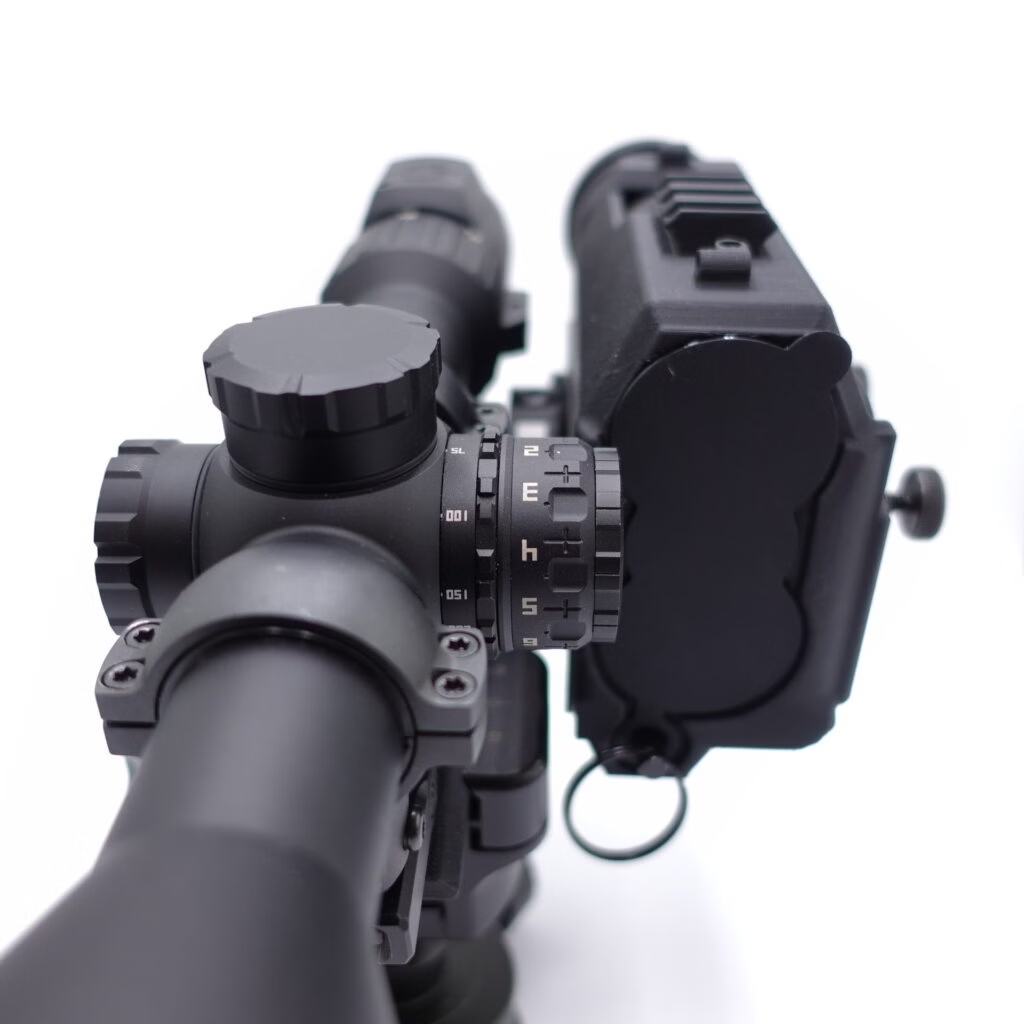
Assuming you’re using a cheapo $130 Sig Sauer KILO2200:
- Longer real-world range than the Tango Fire4000 — 1,600 yards vs. 1,500 on trees, at a fraction of the price
- Snaps off the rail in a second so you can range a target without pointing your muzzle at it — no dedicated WMLRF can do this
- A narrower, round beam instead of a wide angled one — reads through brush and clutter instead of returning false hits
- No firmware gamble — no silent dope failures, no phone-angle slope bug
- A company with a real track record standing behind the electronics, not a silent startup
Q: Is the Tango Fire4000 worth it?
Q: Is the Tango Fire4000 any good?
A: At $1,500 we don’t think so. The Tango Fire4000’s one genuine strength is that it’s an all-in-one unit with a wired remote, which spares you the Bluetooth headaches that plague the Vortex Impact 4000 — and that wired remote is genuinely the fastest way to trigger a range of any option here. Against that you’re getting shorter real-world range than a $130 handheld, no onboard environmental sensors, a wide angled beam that struggles around clutter, two unfixed firmware bugs that affect your firing solution, and a company with a poor documented support record. If you want a weapon-mounted rangefinder, a quality handheld in a Sightlok RF-1 mount does the same job better for less.
Q: How far can the Tango Fire4000 actually range?
A: In real-world conditions, roughly 1,500 yards on trees and 1,200 yards on animals — well short of the manufacturer’s estimates, and short of a $130 Sig Sauer KILO2200, which manages about 1,600 and 1,300 yards respectively. Reflective-target numbers quoted in marketing material are not what you’ll see on game or on a steel plate in brushy terrain.
Q: Is the Tango Fire4000 accurate?
A: Its distance readings suffer from the same beam problem as the Vortex Impact 4000 — a wide, angled beam that catches branches, grass and terrain alongside the target and returns a false or blended reading. Separately, its firing solutions can be wrong for two other reasons: the continuous ranging bug stops updating dope after 2–3 ranges with no warning, and with the phone app connected, slope calculations use the angle of your phone instead of the angle of your rifle. So even when the distance is right, the dope may not be.
Q: Who makes the Tango Fire4000, and is it really designed in the U.S.?
A: It’s sold by Tango Innovations (Tangoinnos) and labeled “Designed in U.S.” That labeling is hard to square with the company’s own FAQ, where it can only speculate about why its engineers omitted environmental sensors from the product. A company that designed the unit would know. The strong implication is that the Fire4000 was designed in China.
Q: Does the Tango Fire4000 have built-in environmental sensors?
A: No. There are no onboard temperature, pressure or humidity sensors, so the unit can’t read the conditions it needs for an accurate firing solution — you depend on your mobile phone or a Kestrel to get that data. Sig builds them into every BDX-enabled handheld from the KILO3K up.
Q: Does the Tango Fire4000 need a phone app, and does it work without an internet connection?
A: The ballistic side of it increasingly does. The original “AB Synapse – BOSS” app is no longer in development and users are being shifted to Applied Ballistics Quantum, which is cloud-based. Depending on a cloud app means you need an internet connection to grab drag curves or new bullet data, often not practical when you’re out in the field — and connecting the app is also what triggers the phone-angle slope bug.
Q: Does the Tango Fire4000 have any known bugs?
A: Two significant ones, both reported on Snipershide and neither fixed. First, engaging continuous ranging causes the unit to keep ranging but stop updating your dope after 2–3 consecutive ranges, silently. Second, with the BOSS app connected, angle compensation is calculated from the phone’s tilt rather than the rifle’s.
Q: What is Tangoinnos customer support and warranty like?
A: Poorly regarded, and documented rather than merely alleged. Owners describe being told they’re wrong rather than being helped — one customer wrote that after reading this article he realized he had been gaslit. Compare that to Sig Sauer’s Electro-Optics Infinite Guarantee, a fully transferable lifetime warranty.
Q: What’s a key advantage of the Sightlok RF-1 over the Tango Fire4000?
A: With the Sightlok RF-1 you can range a target without pointing your rifle at it. The Tango Fire4000 is one integrated, weapon-mounted unit with no separable ranging function — to range anything, you point the rifle, and the laser riding on top of it, directly at whatever you want a number on. That rules out scouting a target, confirming a distance on something you’re not ready to shoot, and ranging near other people or livestock. With the Sightlok RF-1 you can pull the rangefinder off the gun and range by hand whenever you want, then click it back onto the rifle, co-witnessed to your scope, and use it as a weapon-mounted rangefinder again.
Q: Which is faster to range with, the Tango Fire4000 or a Sightlok RF-1 setup?
A: The Tango Fire4000, and we’ll say so plainly. Its wired remote sits by your trigger hand, so a range costs you a button press and nothing else. A handheld in a Sightlok RF-1 has no remote — you reach up and press the button on the rangefinder itself, which adds one to three seconds. That’s still quicker than the Vortex Impact 4000’s Bluetooth remote, which either has to be kept awake or woken up and re-paired, but it’s slower than a wire. If absolute speed with your hand never leaving the grip is your top priority, that’s a point in the Tango’s favor.
Q: If I don’t already own a good handheld rangefinder, what would you recommend to use with the Sightlok RF-1?
A: Obviously this depends on how far you’re shooting. If you’re shooting ultra-long distance, you may need something like a Sig KILO8K-ABS or a Sig KILO5K. But really any handheld rangefinder should be perfectly sufficient for most shooters. It doesn’t have to be a Sig Sauer. And many run-of-the-mill handheld rangefinders out there actually outperform the Tango Fire4000 in terms of beam range and quality. For example, the laser in the $130 Sig Sauer KILO2200 outperforms the laser in the Tango Fire4000, and the software in the Sig is better as well. So evaluate your own shooting objectives and choose a rangefinder which meets those objectives. There’s no need for everyone out there to own a Sig KILO8K-ABS — that would be way overkill for most.
Q: What is the beam divergence and beam pattern of the Tango Fire4000 versus the Sig KILO2200, KILO5K, and KILO8K-ABS?
A: Tango Innovations doesn’t publish a beam divergence figure for the Fire4000 — which is itself telling, since every Sig unit below states one openly. What field reports describe is the same wide, canted beam seen on the Vortex Impact 4000, whose published figure is included here for reference:
| Rangefinder | Beam divergence | Beam pattern |
|---|---|---|
| Tango Fire4000 | Not published | Field reports describe a wide, angled beam |
| Vortex Impact 4000 (for reference) | 2.0 x 0.2 MRAD | “Slash-shaped,” canted 45° |
| Sig KILO2200 | 1.4 MRAD | Round |
| Sig KILO5K | 1.3 MRAD | Round |
| Sig KILO8K-ABS | 1.2 x 0.25 MRAD | Rectangular, wider than tall |
If range, a clean beam, firmware you can trust, honest labeling, and a company that answers for its own product matter to you, a handheld rangefinder in a Sightlok RF-1 beats the Tango Fire4000 on every one of these counts.
Who is Sightlok?
Sightlok publishes 100% factual, unbiased reports and reviews on electro-optics gear, with a particular focus on weapon-mounted laser rangefinders (WMLRF). Sightlok is the world’s leading independent expert on the various WMLRF options currently available. Sightlok is also the engineering and manufacturing team behind the highly-regarded Sightlok RF-1. If we can help someone find a product which perfectly meets their needs, or avoid a product which is less-than-ideal, our efforts were not in vain.
Where is this information sourced from?
The information is sourced from our own experiences with products in the field, and from customers we communicate with in the course of doing business, and from respected members posting on forums like Snipershide, Rokslide, and LongRangeHunting.
Did we miss anything in this report?
Disagree with anything we had to say?
Your opinion is precious, we would love to hear your feedback.
Any comments you leave below are published instantly, there’s no need to register before posting or verify your email address.
Ready to Build a Better WMLRF?
Keep the rangefinder you already own, mount it to your rifle, and co-witness it to your scope — for a fraction of what the Tango Fire4000 costs.







A link or two to see who designed and manufactures the Fire4000:
https://apps.fcc.gov/eas/GetApplicationAttachment.html?id=7879019
(from https://apps.fcc.gov/oetcf/eas/reports/ViewExhibitReport.cfm?mode=Exhibits&RequestTimeout=500&calledFromFrame=N&application_id=HuxY3UutNSVUgxZFJpW9oQ%3D%3D&fcc_id=2BMHK-FIRE4000)
https://www.henrichtechnology.com/product/ballistics-computer/
Hey Julep, thanks for that tip. Yep, seems that Henrich, which sounds German, is the Chinese manufacturer, and they may even run Tango Innovations. Hope that’s not the case.
I’ve been texting back and forth with Marcus with the Tangoinnos company… after reading this blog post I realize I’ve been gaslit. Nonsense about the processor in the kestrel being too slow but it doesn’t work any better with the phone app. Very disappointed to read this but at least now I know I’m not doing anything wrong
Sorry to hear you’re not getting the answers you need from the company. Can you please provide more information about the problem you’re having?
I am having trouble with the 4000 it won’t hold zero and I have to constantly readjusting it, I am hoping they will replace it have a call in it’s been one days and no response yet.
Has your problem been solved?
At least one long-time Sniperhide member who had bad things to say about the Tango 4000 Fire WMLRF had his Snipershide account deleted. One thing you find almost universally is when people spend a pile of money on something, they want it to be perfect. They don’t want people criticising it. If you criticize their baby, they can get very upset and defensive, even denying serious flaws and problems. This is the sunk cost fallacy. The sunk cost fallacy is the tendency for people to irrationally defend their buying decision based on the fact that they’ve already invested a sizable chuck of money. If you want to critically evaluate the Tango 4000, this is a safe place to do it.
Just installed a fire 4000 and it’s very inaccurate in it’s dope by more than 30 yards, waiting for some one to get back to me, all the other data was no problem inputting in the fire 4000 it’s just off big time on accuracy, don’t know if it’s me or the unit I hope it’s a simple fix the unit is well built Donald.
Donald, really appreciate the feedback. Hope you get the issue figured out. Please follow up whatever happens!